
Irish edition
The day your family can't ask you, this folder tells them what to do.
Your will deals with who gets what. It has nothing to say about the first phone call, the account the mortgage is paid from, the form Revenue wants before probate can even be applied for, or the social welfare payment that can carry on for six weeks. Kinfold covers all of that. You write your answers down once, and your family gets a step-by-step roadmap for what follows a death in Ireland: the first 6 weeks, then 3 months, then 12.

- Three stages, three real Irish time limits
The 6-3-12 roadmap walks your family through the first 6 weeks, the first 3 months and the first 12 months, one stage after the other.
- What to do, and where everything is
The roadmap gives them the steps. The 15 fill-in sheets you complete give them the answers. All of it is in everyday English, with the legal terms explained.
- 13 letters with the wording done
For Revenue, the Department of Social Protection, the bank, the credit union, the insurers, the pension scheme and the others who each have to be told separately.
- Irish pensions and payments, as they really work
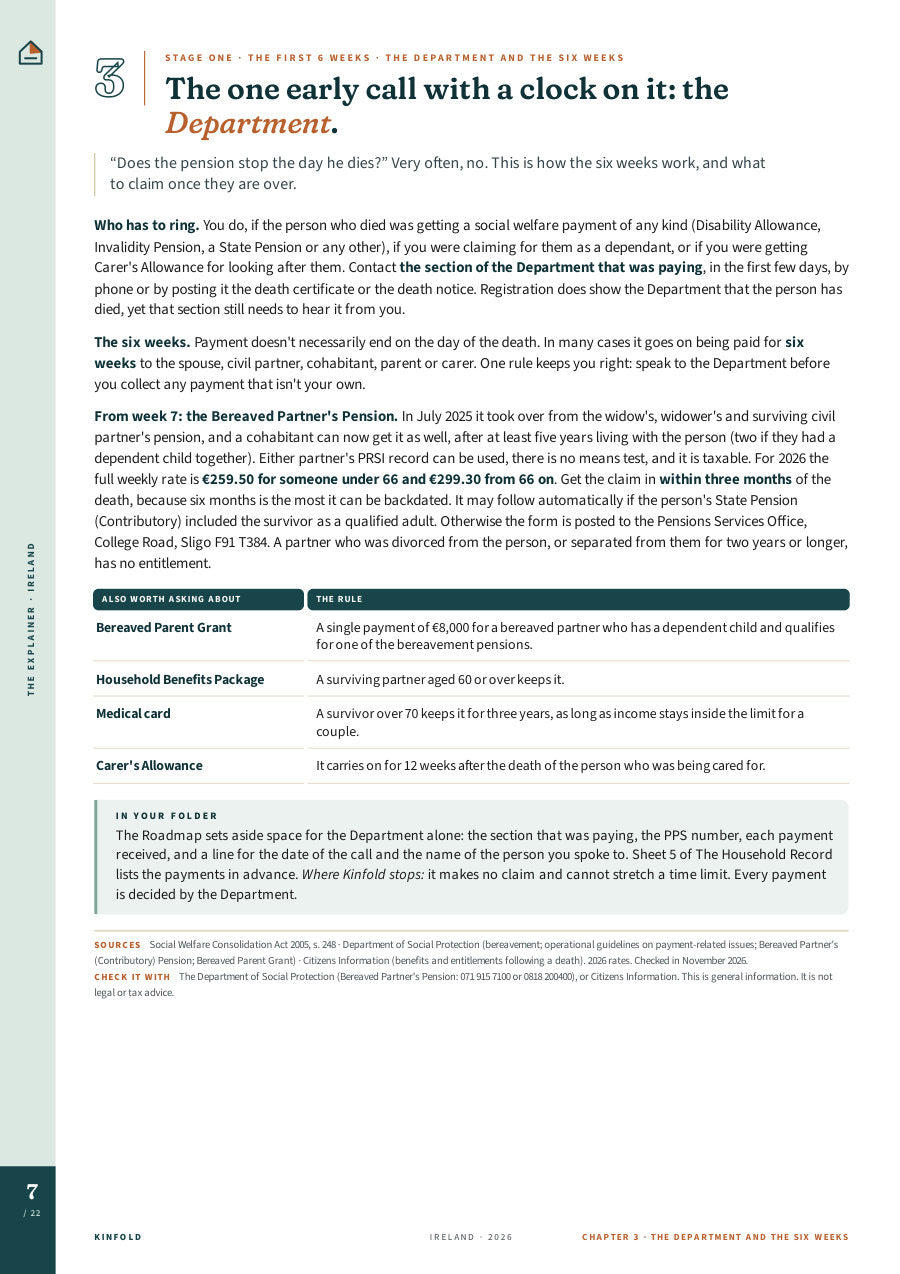
The six weeks in which many payments still go to a surviving partner, the Bereaved Partner's Pension that can follow from week 7, and the money that never passes through a will: pensions, life cover, a credit union nomination.
- Twenty minutes gets you going
Three sheets cover what your family would be asked for first. Start with those and leave the rest for another day.
Irish edition. Sent to you by email.
One payment. No subscription.
- Arrives by email after you pay
- Type into it on screen or print it at home
- One folder is enough for a couple
- Sent by email
- Fill in on screen or on paper
- 60-day money-back guarantee
- Made for the Republic of Ireland
After the funeral comes the paperwork, and it falls to the people you love.
From the day of a death until the estate is finally wound up, there is a long line of forms, deadlines and phone calls, and hardly anyone has been shown how any of it works. No office in Ireland does it on the family's behalf: the registrar doesn't, the bank doesn't, the Department doesn't. Even registering the death is the family's own job. So it comes down to a husband or wife, a daughter or a son, who has never done it before. Here is how it tends to go.
Nobody knows what there is
Your family starts with a locked phone, a press full of envelopes and a box of old statements, and tries to piece together which banks, pensions and policies you ever had. Where are the deeds to the house? Was there a pension from that job back in the nineties? Is the life policy still in the biscuit tin in the attic?
Each account, pension and policy is written down, with the next step beside it.
Some of your money never goes near your will
A death benefit that a pension scheme or a life policy pays to a named person passes outside your will. So does the first €27,000 in a credit union account that has a nomination on it, and so does a home held as joint tenants. The will and the forms can end up pulling in different directions, and no one sends your family a list of the schemes you were ever in.
Each scheme and policy, the name on it, and the date you last looked.
The money is stuck while the bills keep landing
Money in your sole name generally stays put until the grant of probate arrives, although a bank may pay out a balance below €20,000 under its own rules. A joint account shared with anyone but a spouse or civil partner may have to wait for Revenue clearance before a balance above €50,000 is paid out. All the while, the loan, the electricity bill and the insurance renewals keep falling due.
What exists, where it is, and which account the household runs on.
A family that applies for probate without a solicitor normally waits that long for its appointment, counted from the day the papers are lodged. The grant follows by post, usually within about 3 weeks (Courts Service, November 2026). And nothing can be lodged until Revenue's Form SA.2 has been filed, listing what the person owned and owed on the date of death. Until the grant comes, money in their sole name mostly cannot be moved, and the Probate Office in Dublin will not fast-track an application because a house sale depends on it.
None of this is a legal tangle. It is simply what happens when there was no plan to follow.
"Ah, they'll figure it out between them."
They will, eventually. It will cost them months on the phone, an account they can't get at, a pension payment that has to be handed back and a deadline they only hear about once it has passed. A written plan saves them all of that: the first thing to do, the next person to ring, and the place where each document lives.
Two families, the same sad day. Only one was left a plan.
The grief is no smaller in either house. What differs is everything that comes after it.
The 6-3-12 roadmap takes your family through the first year, one stage at a time.
The three numbers are real Irish time limits, each counted from the date of death. For 6 weeks, many social welfare payments are still paid to the surviving partner. Within 3 months, the death should be registered and the claim for the Bereaved Partner's Pension made. And for 12 months, known as the executor's year, a beneficiary needs a court's permission to sue the executor for not having shared out the estate. For each stage the roadmap sets out the next step, so your family is never making it up as they go.
Make things safe, tell the first few
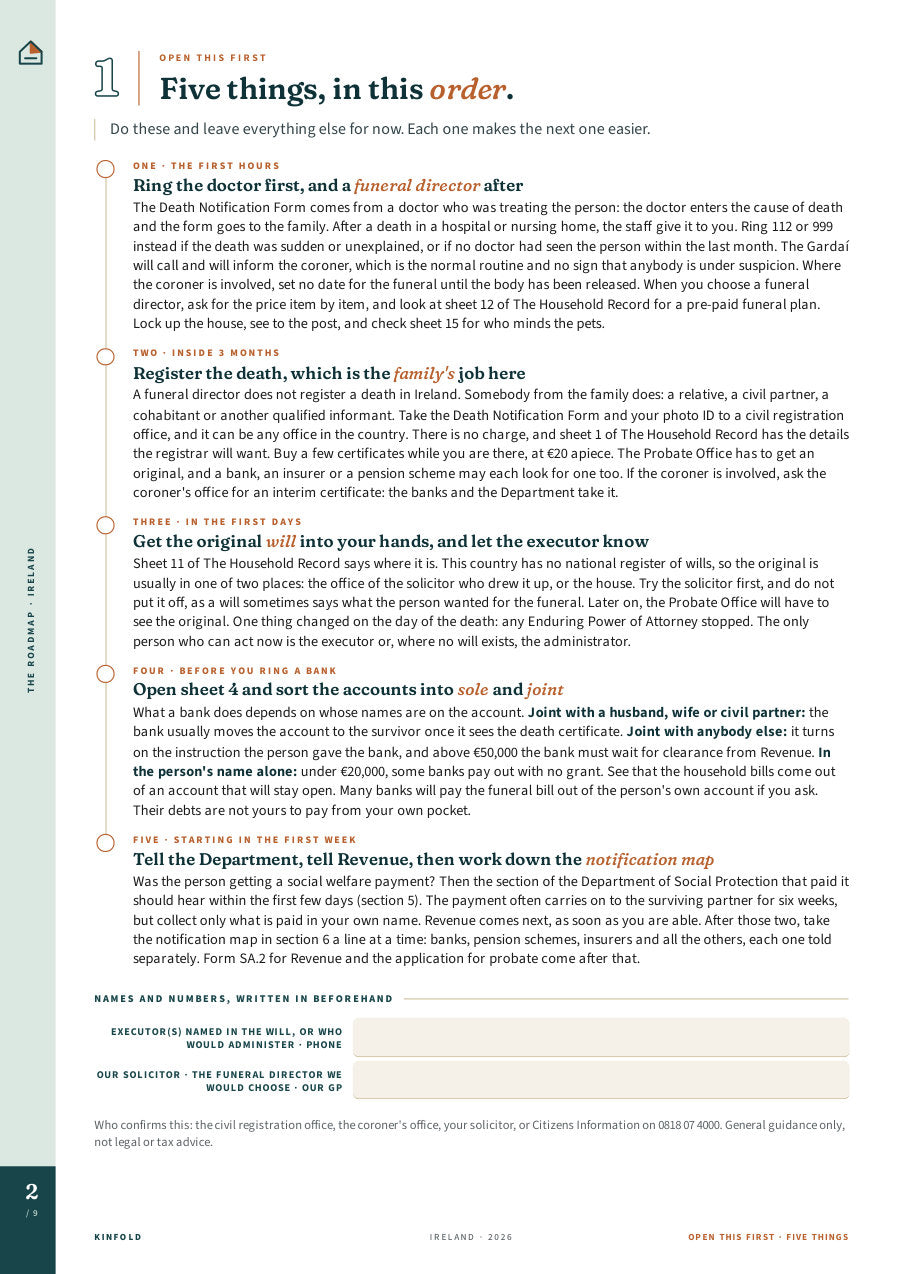
In this order: the Death Notification Form from the doctor, or 112 or 999 and the Gardaí where the death was sudden. A funeral director, an itemised quote, and a check for any funeral plan already paid for. A call in the first few days to the Department of Social Protection, to the very section that was paying the person. The original will, which is usually sitting with the solicitor. A note of which accounts were in one name and which were joint, made before anyone rings a bank. Then Revenue.
Someone pays the undertaker out of their own savings, a pension payment is collected and has to be returned, and the will turns up too late.
Register, claim, tell everyone
A member of the family registers the death at any civil registration office. Registering costs nothing, and a few certificates can be bought there at €20 apiece. A claim goes in for the Bereaved Partner's Pension, which is payable from week 7. After that, one at a time and using the letters in the folder: the employer, the insurers, every pension scheme, the credit union and the banks. Form SA.2 goes to Revenue online, and the probate papers are lodged.
The same sad story told afresh to each caller, a late pension claim (backdated by 6 months at most), and a policy that never comes to light.
The executor's year
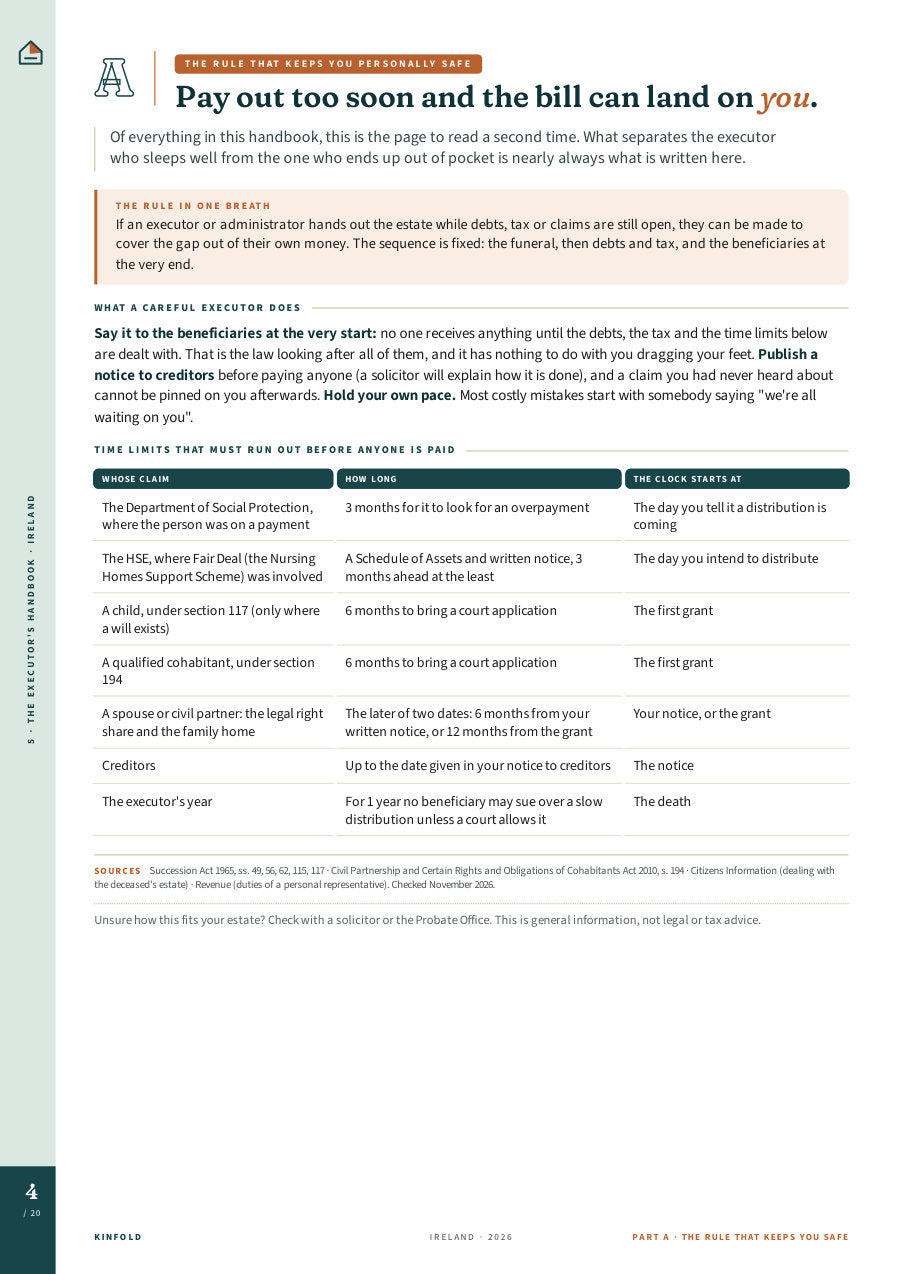
The probate appointment, then the grant. Written notice to the spouse or civil partner of two rights: the legal right share, and the right to take the family home as part of it. Notices to creditors, a check with the Department for any overpayment, and tax paid up to the date of death. Next come the 6 months after the grant in which a child or a cohabiting partner may bring a claim. Only after all that is the estate divided, with the papers a solicitor would want already in order.
The estate handed out too soon and the executor left personally liable, a claim that arrives out of the blue, a family row.
The steps for your family and the facts from you, together in one folder.
The roadmap is the half your family follows. The record is the half you fill in, so they know where things are. All of it is written for Ireland, where the same law applies in every county. The few things that do change from place to place, such as the bye-laws of a burial ground or the probate registry that serves your county, are flagged on the page.


The Roadmap
The five things to do first, the 6-3-12 roadmap in three stages, the same year laid out month by month, how the six weeks of continued payments work, who hears about a death automatically and who doesn't, and the full list of everyone else to tell, in the right order.
The Household Record
Fifteen guided sheets: your accounts, pensions, policies and bills, the house, the phone, your enduring power of attorney and advance healthcare directive, the solicitor who has your will, and a sheet for the pets, the plants and the people who rely on you.
Letters Ready to Send
To Revenue and the Department of Social Protection, to the bank or the credit union, the pension scheme, the life insurer and the mortgage lender, to the employer and the energy supplier, right down to the club or gym membership that needs cancelling. Put in the name, sign it, send it.
The Executor's Handbook
For your executor, or the administrator if there is no will. Form SA.2 for Revenue, getting the grant with or without a solicitor, what the Probate Office charges, the legal right share, the 6-month claim periods, the executor's year, and a handover sheet for a solicitor.
House and Home
Mortgage protection cover, the Land Registry (now part of Tailte Éireann), whether the house is held as joint tenants or as tenants in common, putting off the Local Property Tax, and what becomes of a tenancy when the tenant dies, with a short checklist for a house left empty.
The Explainer
The background to all of it, in ordinary words, with the source given for every figure. And Open This First, a short read-me that says what each file is and what to do with it today.
The Ask List. Fifty questions that land on a family in the first months, each with a pointer to the sheet that answers it.
The Dry Run. A twenty-minute trial that shows the folder does its job.
Online Keys. How your family gets into the phone and the accounts behind it.
The House Checklist. Minding a house when there is nobody living in it.
It all comes by email. Type straight into the sheets or print them at home, and keep the lot together in one folder.
Set aside one unhurried afternoon. That is the whole job.
Each sheet puts simple questions to you and shows where every answer goes. You never face an empty page, and you need no legal knowledge at all. Do a bit, leave it, come back to it: the pace is yours.

Do three sheets this evening
Who you are, where things are kept, and your bank accounts. Between them they answer most of what your family would be asked in the first month. Allow about twenty minutes, at the keyboard or with a pen.

Try The Dry Run some Sunday
Pass the folder, shut, to whoever would be using it, and set a timer. Can they put their hand on your will, the account the mortgage is paid from and the right person to phone about your pension? If they can do it inside twenty minutes, the folder works. Put the date on The Dry Run page.
Put it where it will be found
Store it with your important papers and let one person know the spot. When the day comes, the first page of The Roadmap, headed "Open this first", gives them five things to do, in this order. Ten minutes a year keeps it current, and that includes the names on your pensions, your life policies and your credit union nomination.
Read twelve of the actual pages before you decide.
These come straight from the Irish edition. Tap any page to open it at full size.


We read the rules, so your family won't have to.
Kinfold publishes practical family paperwork. We are not solicitors or tax advisers and we never pretend to be. What we do is the legwork: reading the rules and turning them into sheets that an ordinary household can fill in at the kitchen table.
For the Irish edition, the rules, fees and time limits were checked in November 2026 and, wherever we could, against official sources: Revenue, the Courts Service, the Probate Office, the Department of Social Protection, the Decision Support Service, Tailte Éireann, Citizens Information and the statutes themselves. You will find the sources listed in The Explainer, so each one can be looked up.
Every form, office and deadline named in the folder is the Irish one.
- Checked in November 2026Rules, fees and time limits, against official sources wherever possible.
- Sources in printListed in The Explainer, so nothing has to be taken on trust.
- The Republic of IrelandOne edition for every county. Northern Ireland is not covered.
The whole folder at one price, with nothing held back.
There is no basic version and no premium version to choose between. Everything listed here comes in the one folder, and all of it is Irish.
Kinfold · The Everything Folder
Irish edition. For anyone who wants to leave the family a plan, whether there is a will or not.
Everything in one place, for the people you love.
- The Roadmap: the five steps to take first, the 6-3-12 roadmap and the list of who to tell
- The Household Record: 15 guided fill-in sheets
- Letters Ready to Send: 13 letters, already worded
- The Executor's Handbook: the grant, step by step, and a calendar for the 12 months
- House and Home, for owners and for renters
- The Ask List, The Dry Run, Online Keys and The House Checklist
- The Explainer, in plain English, and Open This First
- Irish law and Irish forms throughout: the Department of Social Protection, Revenue, the Probate Office
- Couples need only the one folder between them
- Sent by email, with Word versions included
One payment. No subscription.
60-day money-back guarantee
For comparison: the Probate Office charges a family that applies for the grant itself €200 for a net estate of €100,000 or less, €400 for one of up to €250,000, and €700 for one of up to €500,000. A solicitor's application carries roughly half those office fees, plus the solicitor's own bill (Courts Service, 2026). Kinfold is no substitute for a solicitor. What it does is hand your family, or whoever is helping them, everything they will be asked for on the first day.
Try it for 60 days. If it's not for you, you get your money back.
Open it. Read The Explainer, fill in the first few sheets, then sit down with your family and do The Dry Run. If you come away thinking it wouldn't help them know what to do, tell us inside 60 days through the contact page and we will refund the full amount. One short message is enough, and we won't ask you why.
Questions worth asking before you buy.
Is this only a notebook with headings?
No. The heart of it is a roadmap: what has to be done, who has to be contacted and in which order, over the first 6 weeks, then 3 months, then the full 12. What you write on the sheets feeds straight into that roadmap, so all your family has to do is follow it.
We have our wills made. Is there any point in this as well?
Yes, because the two do different jobs. A will settles who inherits. It won't show your family where anything is, which pension scheme to phone, which bills to cancel or who should hear first. Some of the largest sums don't pass under the will in any case: a house held as joint tenants, a credit union nomination, a life policy or pension that names a beneficiary. The folder supplies that practical side and sits alongside the will. And since there is no national register of wills in Ireland, it also notes which solicitor is holding your original.
Does it work the same in every county?
It does. The law is national: probate, wills, powers of attorney, social welfare and Capital Acquisitions Tax are the same in every county. Only two things vary locally, and the folder marks both. One is the rules of the burial ground, which the local authority or the parish sets. The other is where the probate papers are sent: for Dublin, Kildare, Meath and Wicklow it is the Probate Office in Dublin, and people in any other county may use either Dublin or the District Probate Registry that serves the county the person lived in. This edition covers the Republic only. Northern Ireland has its own legal system, so it is left out.
How does the folder reach me?
By email. Once you have paid, we send you an email with a link to your files. Save them to your computer and type into them, or print them at home and put them in any ring binder you have.
What if I don't own a printer?
You can do without one. You can fill in and save every sheet on your screen, and the five main files come as Word documents too. If you would like your family to have paper in their hands, print The Roadmap, the pages they would open first, beginning with the five steps to take first and the 6-3-12 roadmap. A home printer is fine, and so is the library or a print shop.
Where does what I type end up?
On your own computer and nowhere else. Nothing you enter is sent to us, and there is no account, no app and no cloud storage involved. Leave bank PINs and full card numbers out of the folder altogether, since an executor has no use for them. Passwords belong on a single sheet, either written out or as a note of where each one is kept. The folder itself should live somewhere secure: a locked drawer, a home safe, or your solicitor's office.
Once the death is registered, isn't everybody informed?
Unfortunately not. A registered death is visible to the Department of Social Protection, yet the section that was paying the person should still hear from the family directly. Revenue is sent the papers by the Probate Office once the grant issues, yet it still expects to hear of the death from the executor as soon as they can manage it. The electoral register only changes when someone asks the local authority. As far as we know, Ireland has no single service that passes the news to every bank, insurer, credit union, pension scheme and utility company in one go, so the family tells them one at a time. The thirteen letters are written for exactly that, and they come in order.
Is it not a gloomy thing to be at?
We would say the reverse. It is tidying up, no different from keeping the insurance papers together, and doing it now with a clear head is a kindness. The alternative is leaving it to somebody who is in shock.
I'd like my mam or dad to have one. Can I buy it for them?
You can. Buy it, send them the files and do the first sheet side by side. An easy way to raise it: "I'm filling in mine. Would you do yours along with me?"
What if it ends up sitting there untouched?
Begin small. The three sheets that matter most take around twenty minutes. Follow them with The Dry Run some Sunday. And if you decide it isn't for you, the 60-day guarantee gets you your money back.
Does this count as legal advice?
No. Kinfold is not a will, and it does not advise you on law, tax or money. It is the practical plan for all the things a will leaves out, and it points your family to the right door when one is needed: Citizens Information (0818 07 4000), a solicitor, Revenue, the Probate Office, the Decision Support Service or the Department of Social Protection. That is also the reason there is no fill-in will inside. An Irish will has to be signed in the presence of two witnesses who are both there together, and a witness forfeits anything the will leaves them, so a will is work for a solicitor.
You've spent a lifetime minding them. Let the last thing you hand them be clear directions.
An afternoon of your time now saves them months of searching. Three sheets this evening, The Dry Run some Sunday, and a place for the folder where it will be found.
One payment. No subscription.
Kinfold is not a will. It does not give advice on law, tax or money. It is an organiser and a practical plan, there to help your family lay hands on what they need and see where to begin. This edition is for the Republic of Ireland. Rules, fees and deadlines change: before acting, check how things stand today with Citizens Information (0818 07 4000), a solicitor, or the official body named on the page in question.
Everything in one place, for the people you love.
© 2026 Kinfold · The Everything Folder · Irish edition