
South African edition
When the hardest day comes, your family will have a plan to follow.
A will is about who inherits. What it can't do is tell your family which funeral policy to claim first, that Home Affairs needs the notice of death within 72 hours, or that the estate must be reported to the Master within 14 days. That's the job Kinfold does. You fill in what only you know, one time, and your family is handed a clear route through everything that follows a death in South Africa: the first 3 days, by day 14 and within 12 months.

- Three South African deadlines, in the order they come
The 3-14-12 roadmap: the notice of death at Home Affairs within 72 hours, the estate reported to the Master within 14 days, and by the first anniversary, every dependant known to the retirement fund and any estate duty paid.
- The steps, and the facts only you know
The roadmap sets out each task in turn. What you write on the 15 fill-in sheets tells them where everything is, from your ID and policies to the bond and the medical aid. Plain English, with every legal word explained.
- 14 letters, already worded
For the bank, SARS, SASSA, the retirement fund, the funeral policy or burial society, the municipality and the medical aid, plus a covering letter for the Master's Office. Each needs telling separately, so each gets its own ready-made letter.
- Funeral cover, grants and retirement funds, explained
Why every funeral policy and burial society card should be found on day one, why a SASSA grant normally stops at the end of the month of the death, and why pension and provident fund money is usually paid outside your will: the fund's trustees share it among the people who depended on you.
- Twenty minutes is enough to start
Three sheets cover the questions that come up first. Fill those in tonight; the rest can keep until the weekend.
South African edition. Comes to you by email.
One payment. No subscription.
- Sent to your inbox after payment
- Type on the laptop, or write by hand on a printout
- A couple needs only one folder
- Comes by email
- Type it in or print it
- 60-day money-back guarantee
- Written for South Africa
The funeral takes a day. The admin after it runs for months, and your family carries it.
From the day someone dies to the executor's final account there is a long trail of forms, offices and deadlines, and almost nobody has been shown how it works. Registering the death at Home Affairs puts it in the population register and cancels the ID, but that doesn't spread the news for you. The Master's Office still has to hear from the family within 14 days, SARS has to be told by the executor, and, as far as we could find, every bank, insurer and fund has to be told separately. The job normally falls to whoever is closest, a spouse or one of the grown-up children, learning it all on the spot. Here is what that looks like.
Nobody knows where to start looking
What they have to go on is a cellphone they can't unlock, a drawer stuffed with envelopes and years of bank statements, and from that they must piece together every account, policy and fund in your name. Where's the original will kept? Did that first job come with a provident fund? Which funeral policy still has its premiums paid up, and is the burial society card in the cupboard or in the cubbyhole of the car?
Every account, policy, fund and burial society on paper, and what to do about each one.
Your retirement fund doesn't simply follow your will
Pension fund, provident fund and retirement annuity money is normally paid out separately from your estate. The fund's trustees decide how to share it among the people who depended on you, and your nomination form guides them without binding them. The fund usually has 12 months from the death to trace every dependant, so it needs to hear about all of them early. No office sends your family a record of the funds you joined over the years.
Each fund, your member number, the date of your nomination form, and everyone who depends on you.
The estate is frozen. The bills are not.
From the day of the death the estate is frozen: nobody may draw money or deal with the assets without the Master's permission. The Master can write to the bank asking it to release money for a reasonable funeral (form MBU 12), but the bank makes the final call. Meanwhile the bond, the levies and the insurance premiums still fall due.
Each asset and where it sits, plus the account the monthly debit orders run from.
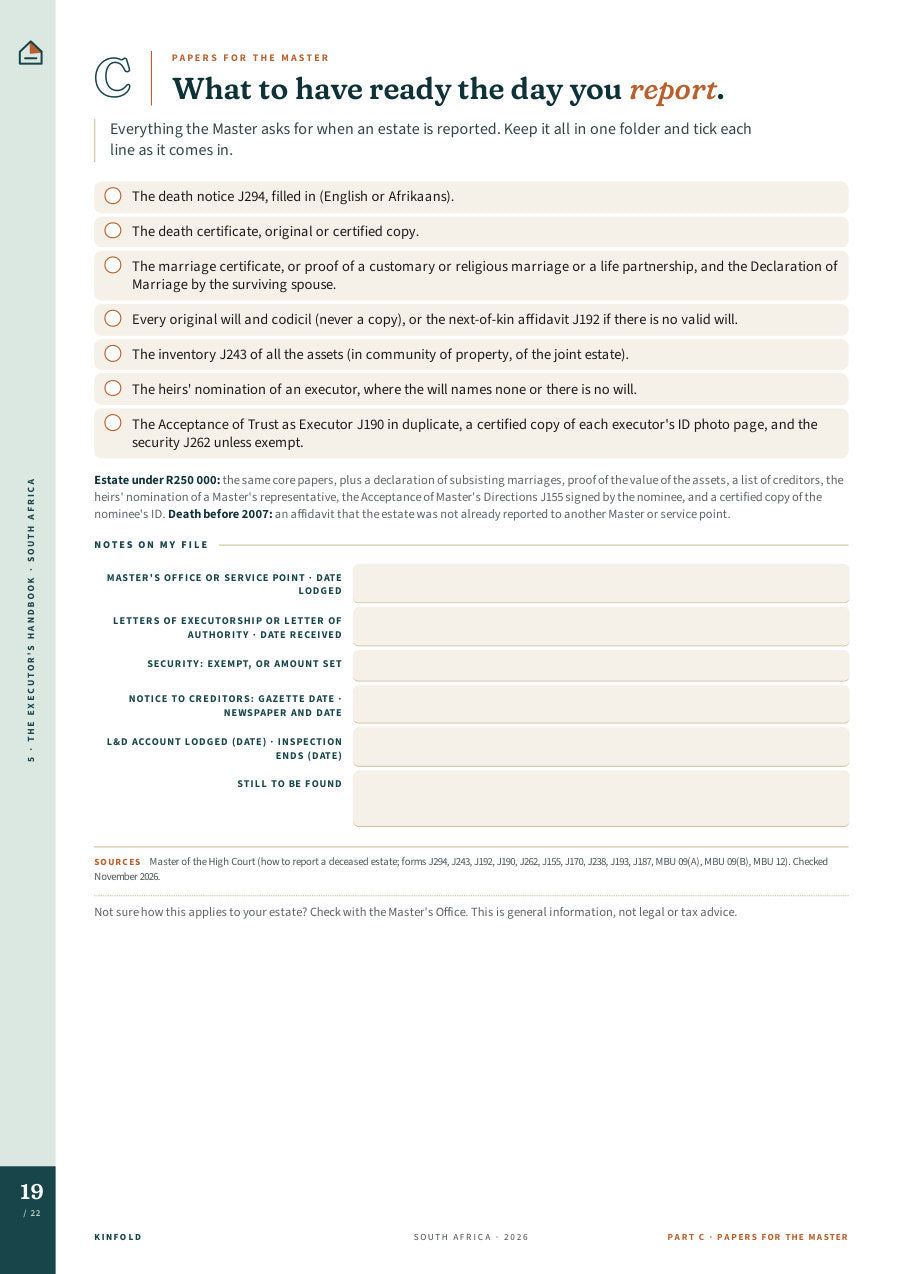
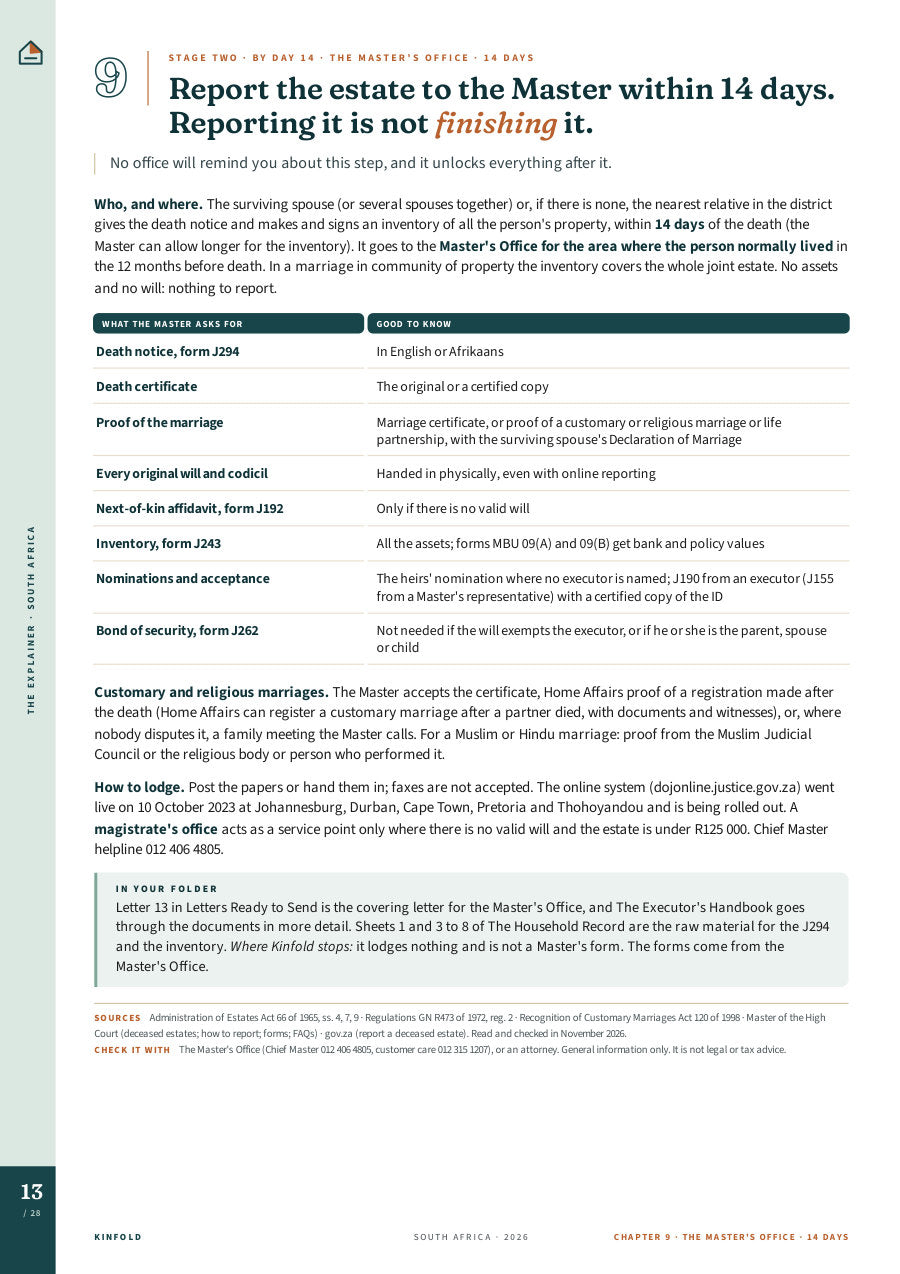
The estate has to be reported to the Master of the High Court within 14 days of the death, at the Master's Office for the area where the person lived. The Master is the government office that oversees every deceased estate and appoints the executor: the person who collects what is owed, pays the debts and hands what is left to the heirs. The family brings the death notice (form J294), an inventory of everything the person owned (form J243), the original will (the Master accepts no copies) and proof of the marriage. Home Affairs does not pass the death on to the Master, and until the Master issues the letters, nobody can wind up the estate.
Not one of these steps is hard in itself. What makes it hard is starting with nothing written down.
"Ag, the kids will sort it out."
They will, in the end. Getting there costs them hours spent queueing or on hold, an account that stays locked, grant money paid after the death that nobody should have drawn, and a deadline nobody mentioned until it had already gone by. Having it on paper spares them the lot: what to do first, who to phone next, and where every document is kept.
Two families say goodbye on the same day. Only one knows what comes next.
Nobody grieves less in one house than in the other. What changes is the month that follows.
The 3-14-12 roadmap tells your family what comes first, and what can wait.
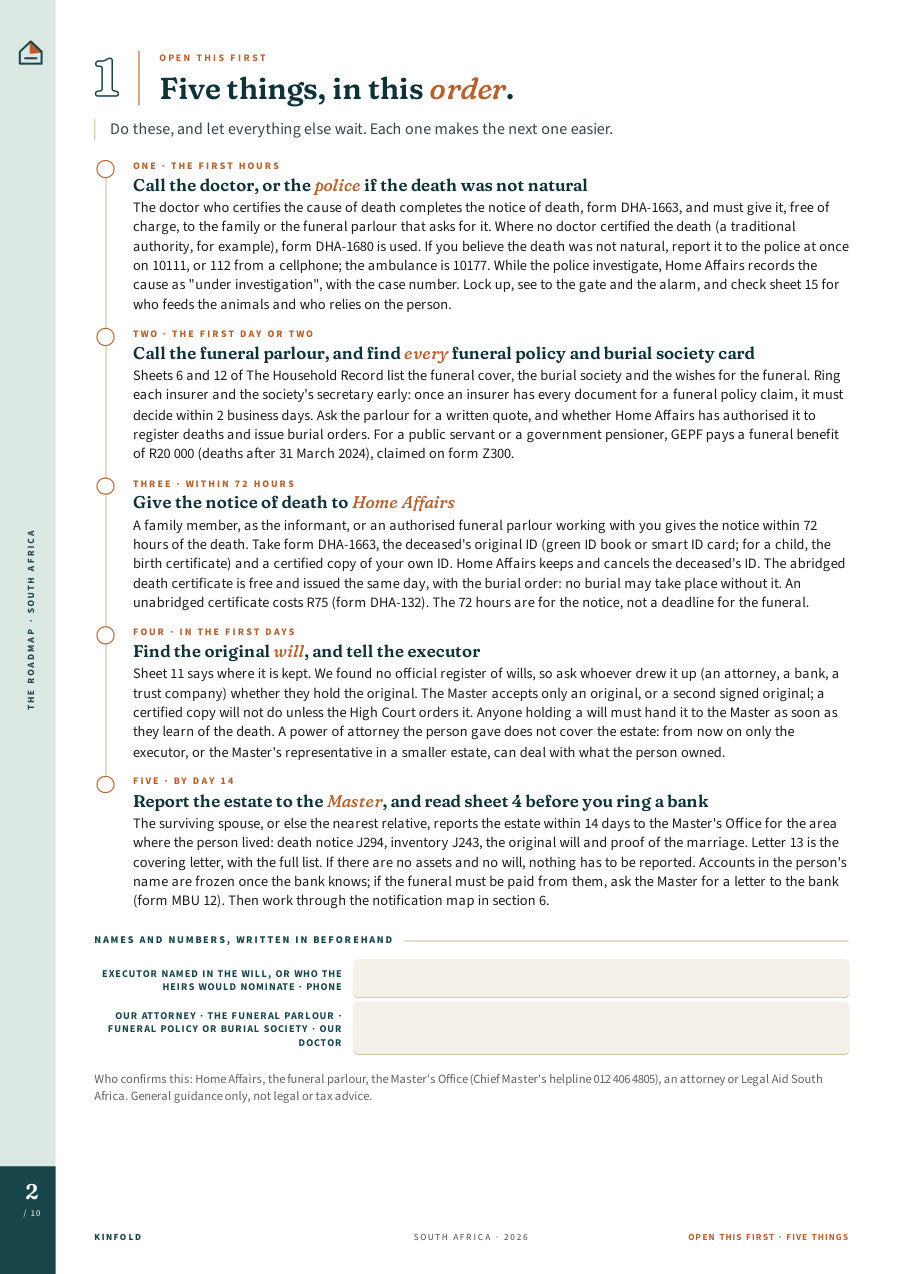
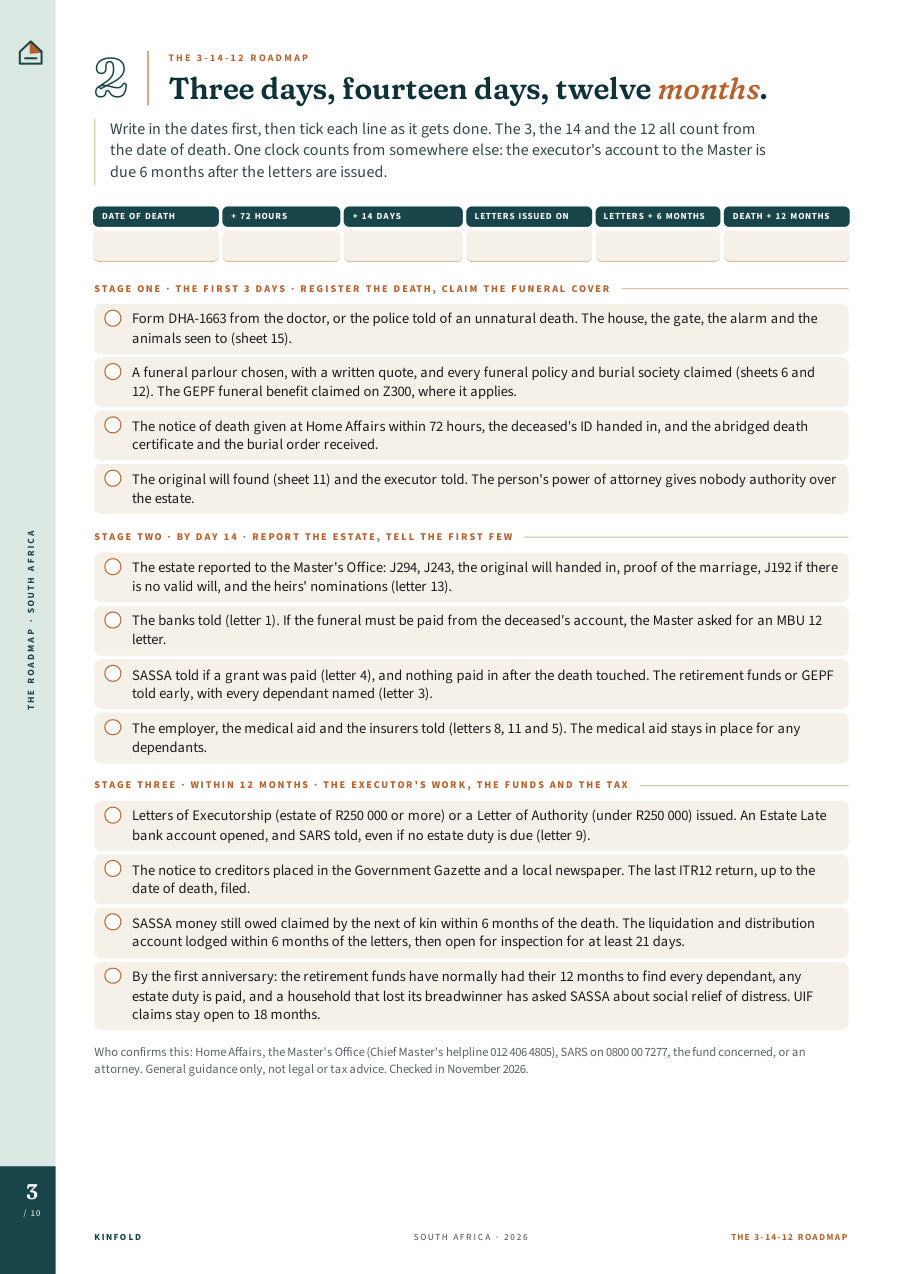
Three real South African deadlines, all three counted from the day of death. Within 3 days (72 hours), the notice of death goes to Home Affairs, and the funeral parlour can do it with you. Within 14 days, the estate is reported to the Master. By the first anniversary, the retirement fund should know every dependant, and any estate duty falls due. At every stage the next move is spelled out, so your family always knows where they stand.
The first 3 days
One after the other. The doctor completes the notice of death (form DHA-1663), free of charge; if the death was not natural, the police come first (10111, or 112 from a cellphone). Then the funeral parlour, and every funeral policy and burial society card, because an insurer must decide a complete funeral claim within 2 business days. The original will is found, since the Master accepts no copies. And within 72 hours the notice of death goes to Home Affairs with the person's ID, which is handed in and cancelled. The abridged death certificate is free and issued the same day, together with the burial order.
The funeral comes out of someone's savings, a policy goes unclaimed, and the original will turns up weeks too late.
By day 14
The estate is reported to the Master's Office for the area where the person lived: the death notice (form J294), the inventory (form J243), the original will, proof of the marriage and, where there is no will, a next-of-kin affidavit (form J192). If the funeral must be paid from the person's own account, the family asks the Master for the letter to the bank (MBU 12). For an estate under R250 000 the Master can issue a simpler Letter of Authority; at R250 000 or more, Letters of Executorship. Meanwhile the folder's letters go out, one by one: the bank, the employer, the insurers, the medical aid, the municipality.
The estate reported late, the same story told to every call centre, and a medical aid cancelled while the children still need it.
Within 12 months
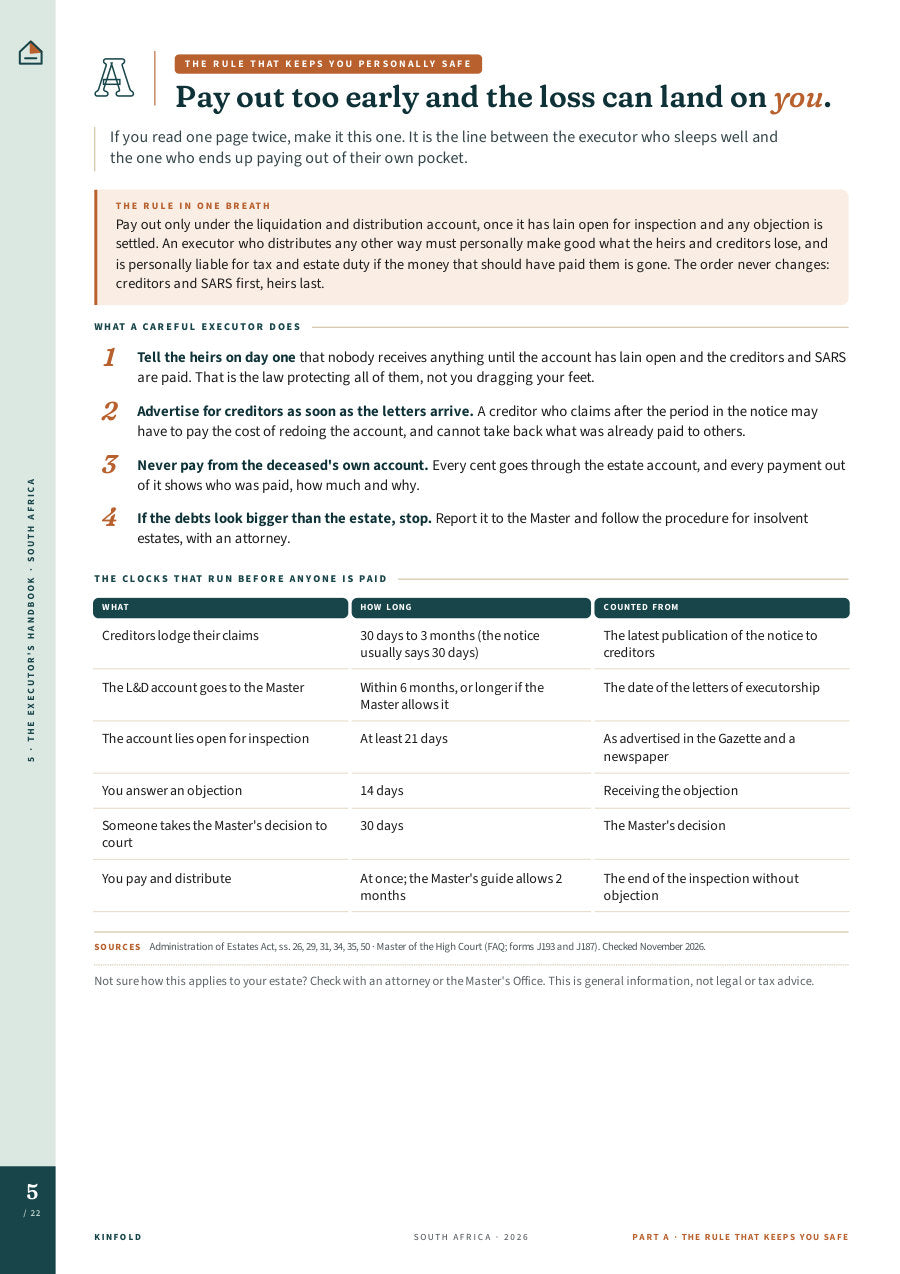
The executor advertises for creditors in the Government Gazette and a local newspaper, then lodges the liquidation and distribution account within 6 months of the letters of executorship. It lies open for inspection for at least 21 days before anything is paid out. SARS is told of the death even when no estate duty is due, and the last tax return runs up to the date of death. By the first anniversary the retirement fund has normally had its 12 months to trace every dependant, and any estate duty is due. A spouse or life partner can still claim UIF dependants' benefits for up to 18 months.
The estate shared out before the account has lain open, the executor personally liable, SARS forgotten, and a family that stops speaking.
A plan for your family on one side, your own answers on the other.
Your family works from The Roadmap; you fill in The Household Record, so they know where to look. Everything is written for South Africa, where one law of succession applies in every province. Where a rule does differ by area, such as cemetery and cremation rules, licensing fees or which Master's Office serves your area, the page says so. The Master's death notice (form J294) can also be completed in Afrikaans.

The Roadmap
The five things to do first, the 3-14-12 roadmap by stage and then by month, what happens to grants, pensions and UIF, who hears of a death automatically when it is registered and who doesn't, and every other organisation to contact, in sequence.
The Household Record
Fifteen sheets, each with simple prompts: your ID and tax number and how you were married, your accounts, retirement funds and any SASSA grant, life and funeral policies and the burial society, the house, the bond and the car, the municipal account and debit orders, the phone, your will and who holds the original, and a sheet for the pets, the plants and the people who rely on you, from the dog to the domestic worker.
Letters Ready to Send
To the bank and the home loan provider, the retirement fund or GEPF, SASSA, the life insurer, funeral policy or burial society, the municipality and the body corporate, the employer, SARS, the investments, the medical aid, the cellphone and DStv, a covering letter for the Master's Office, and finally the gym or club membership that needs cancelling. Fill in a name and a date, sign, and post or email it.
The Executor's Handbook
For the executor named in the will, the one the Master appoints, or the Master's representative of an estate under R250 000. The 14 days and the documents, the estate bank account, the notice to creditors, the liquidation and distribution account and its 21 days of inspection, estate duty and the last tax return, and the costly mistakes to steer clear of.
House and Home
How the home is owned (in community of property, half is already the survivor's), the transfer by a conveyancer at the Deeds Office, why an inheritance carries no transfer duty, the rates and levy clearance, the bond, keeping the house insured, a lease when the tenant dies, the car at the licensing department, and what to check while a house stands empty.
The Explainer
Why each step exists, in everyday words, from the Master and the executor to estate duty and why most families pay none, with the source of every figure. Plus Open This First, the read-me that explains each file and where to begin.
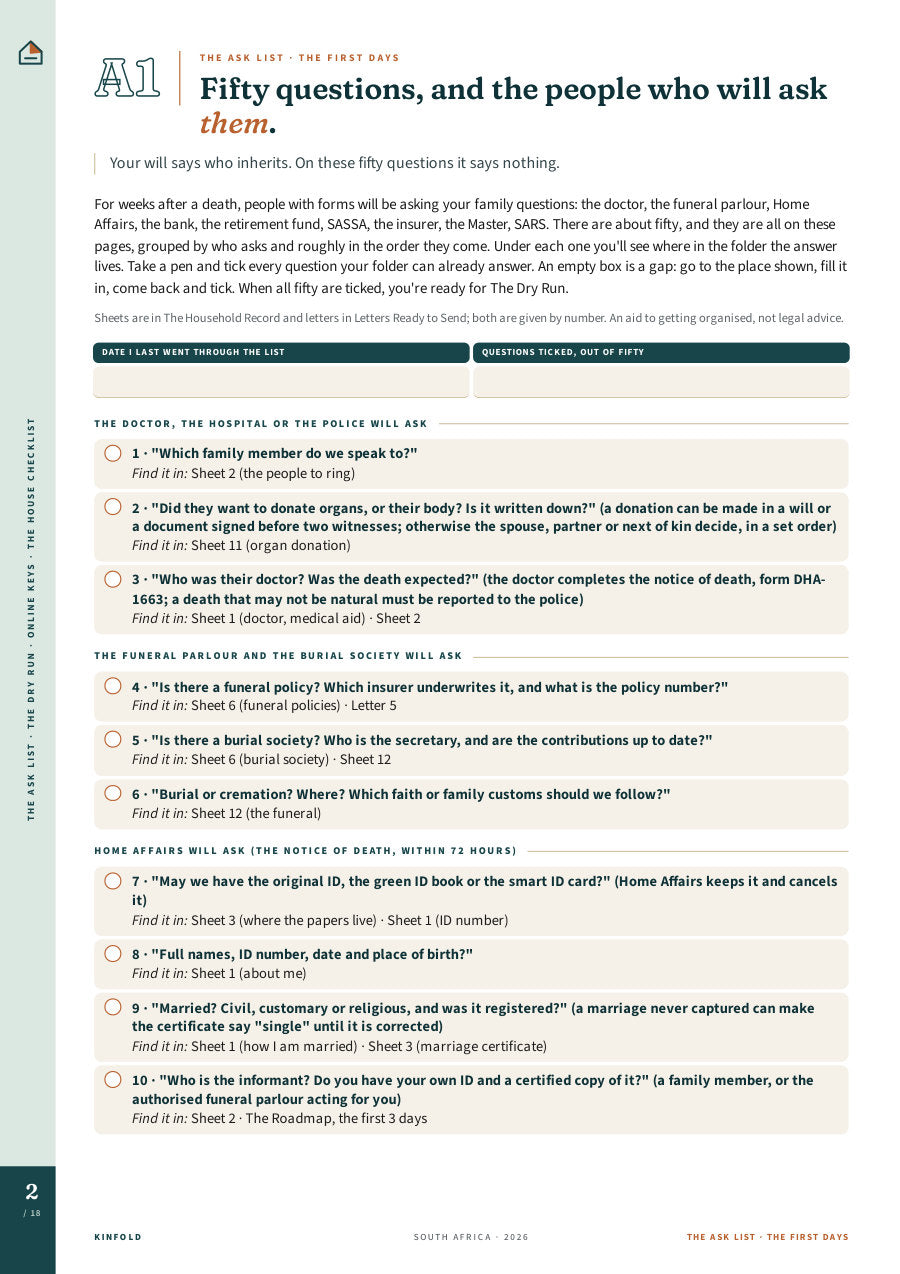
The Ask List. Fifty questions for the funeral parlour, Home Affairs, the Master, the bank and the rest, each linked to the sheet where you wrote the answer.
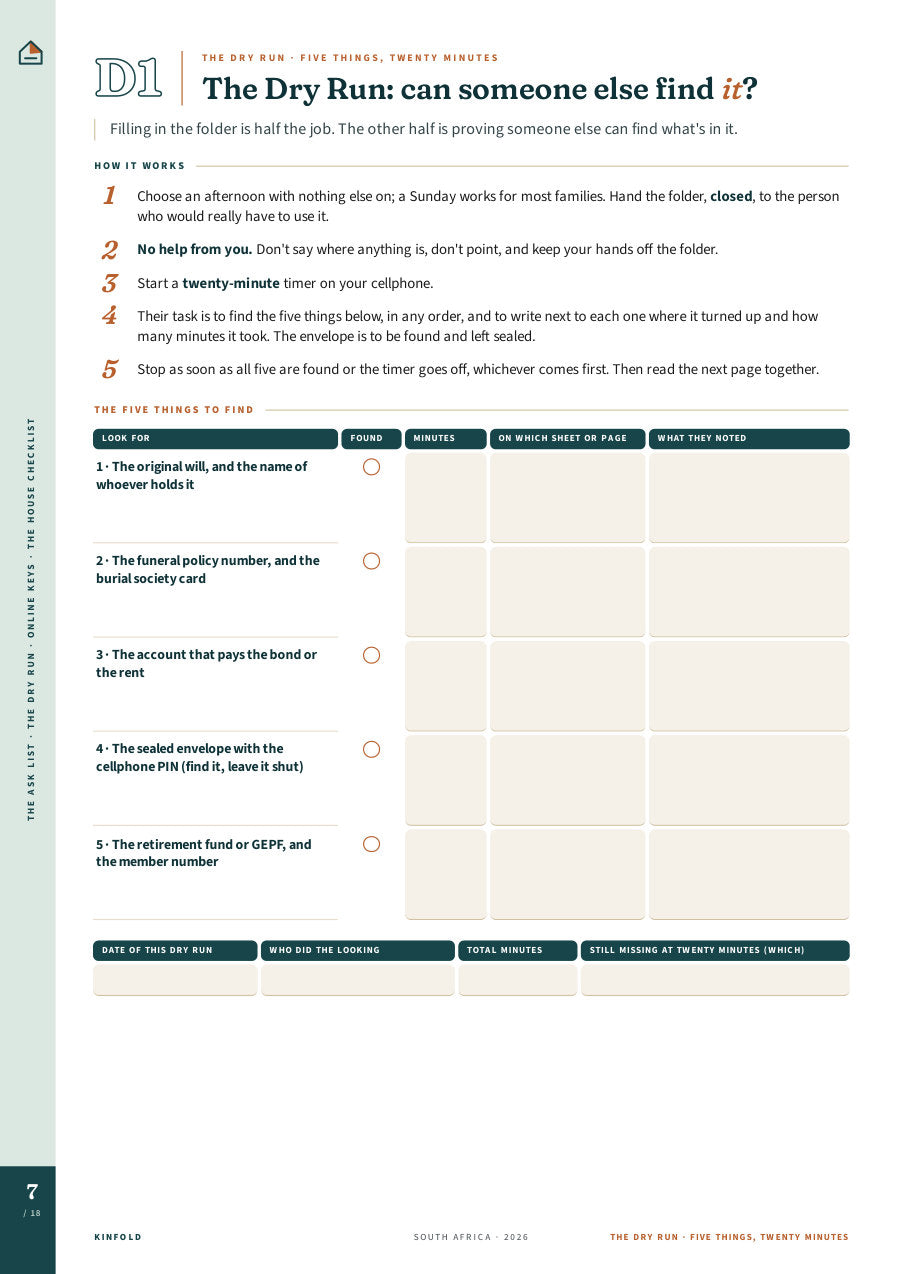
The Dry Run. A twenty-minute test that proves the folder works.
Online Keys. What your family needs to unlock the cellphone, the laptop and your online accounts.
The House Checklist. Looking after a house nobody lives in: keys, the alarm and armed response, the prepaid meter.
Everything is delivered by email. Work on screen or print the pages, then keep them in one lever arch file.
Give it one Sunday afternoon. That's really all it asks.
Each sheet walks you through with short, plain questions and a space for every answer. You won't stare at an empty page, and no legal knowledge is needed. Stop whenever you like and pick it up next week: it goes at your speed.

Do three sheets tonight
Your personal details and family, where your documents are kept, and your bank accounts. Those three answer the bulk of what the Master's Office and the bank will want to know in the first month. About twenty minutes, on the laptop or with a pen.
Do The Dry Run over a weekend
Hand the folder, closed, to the person who would use it, and start a timer. Can they find your funeral policy number, the name of whoever holds your original will, and the account the bond is paid from? Twenty minutes or less means the folder works as it should; write today's date on The Dry Run page.
Keep it where it will be found
File it next to your ID documents and policies, and show one person the spot. The Roadmap starts with a page called "Open this first": five tasks, in order, for the day it is needed. A quick check once a year, about ten minutes, keeps it right: the beneficiaries on your policies, the nomination forms of your retirement funds, and your will after a marriage or a divorce.
Have a proper look inside: twelve pages straight from the folder.
All twelve are taken from the South African edition. Tap any page to enlarge it.



The rules, the forms and the deadlines, checked and put into plain English.
Kinfold produces practical paperwork that helps families get organised. Nobody here is an attorney or a tax practitioner, and we don't claim to be. What we bring is the groundwork: the official rules read through, checked, and rebuilt as sheets that make sense at the dining table.
For the South African edition, the rules, forms, fees and deadlines were checked in November 2026, against official sources wherever we could: the Master of the High Court, Home Affairs, SARS, the Deeds Office, GEPF, gov.za, and the Acts as published by the Department of Justice. The Explainer prints the source for each figure, so you can check any of it yourself.
Every form, office and deadline in the folder is a South African one.
- Checked in November 2026Compared with official publications wherever they were available.
- Sources in printNamed in The Explainer, ready for you to check.
- One edition, all nine provincesThe same law of succession from Musina to Cape Agulhas.
One price for the whole folder, with every part included.
You don't choose between packages: everything on this list comes together, written for South Africa from the first page to the last.
Kinfold · The Everything Folder
South African edition. Made for any household, whether a will has been drawn up yet or not.
Everything in one place, for the people you love.
- The Roadmap: five things to do first, the 3-14-12 roadmap, and the full list of who to notify
- The Household Record: 15 guided fill-in sheets
- Letters Ready to Send: 14 letters with the wording done for you
- The Executor's Handbook: from the Master's letters to the final account, step by step
- House and Home, covering owners and tenants
- The Ask List, The Dry Run, Online Keys and The House Checklist
- Open This First and The Explainer, both in plain English
- South African law and forms throughout: Home Affairs, the Master, SARS, SASSA
- One folder is enough for a couple
- Arrives by email, and files 1 to 5 also come in Word
One payment. No subscription.
60-day money-back guarantee
For comparison: unless the will sets another fee, an executor may charge 3,5% of the gross value of the estate, plus 6% of any income collected after the death, with VAT on top if the executor is registered for it, and the Master's Office charges its own fees on larger estates. Kinfold won't do an attorney's or an executor's work. It makes sure that whoever does it starts with every name, number and document already gathered.
Use it for 60 days. If it's not right for you, we refund you in full.
Go through The Explainer, complete a handful of sheets and run The Dry Run at home. If, after all that, you don't think it would help your family, write to us through the contact page within 60 days for a full refund. One short message does it, no reasons needed.
What people usually ask before they buy.
Is it really more than a notebook with headings?
Yes. At its heart is a roadmap: what has to be done, who has to be told and in which order, in the first 3 days, by day 14 and within 12 months. The sheets you complete supply the details each step needs, so your family simply works down the list.
We already have wills. Why would we need this too?
Your wills settle who inherits what. The folder handles everything around that: where the papers are, which funeral policy to claim, which fund to phone and who should hear the news first. Some of the biggest amounts don't go through the will at all: a retirement fund's death benefit is shared out by the fund's trustees, and a policy with a named beneficiary is paid to that person. And as far as we could find, South Africa has no official register of wills, so a sheet also records who holds your original will, since the Master won't accept a copy.
Is it the same in every province?
Yes. The law of succession is national: wills, inheritance without a will, the Master, estate duty and the 72-hour notice of death work the same way from Limpopo to the Western Cape. Three things vary locally, and the folder flags them: cemetery and cremation rules and fees, which the municipality sets; licensing department fees, which each province sets; and which Master's Office serves the area where the person lived. Customary and religious marriages count for inheritance, but they have to be proved to the Master, so sheet 1 notes how you were married and where the proof is kept.
How do I receive it?
By email: once payment goes through, a message arrives with a link to the files. Store them on your laptop and work on screen, or print them for a lever arch file.
I don't have a printer. Is that a problem?
Not at all. Every sheet can be filled in and saved on screen, and files 1 to 5 also come in Word. If you'd like your family to have paper in hand, print The Roadmap first, starting with the five first steps and the 3-14-12 roadmap. Any home printer will do, or take the files to a library or any print shop.
Who can see what I type?
Only you, and anyone you choose to show. Everything stays on your own computer: nothing is sent to us, and there's no app, no account and no cloud. Bank PINs and full card numbers don't belong in it: no executor ever needs them. Keep passwords together on one sheet, either the password itself or a hint to where you store it. Then put the folder somewhere secure: a locked drawer, a safe at home, or with your attorney.
Once Home Affairs registers the death, doesn't everyone find out?
Only a few. Registration records the death in the population register and cancels the ID. SASSA checks its payments against Home Affairs every month, and GEPF checks its pensioners every year. But the Master is not told: the family must report the estate within 14 days. SARS has to hear from the executor, even when no estate duty is due. And as far as we could find, no single service tells every bank, insurer, fund, medical aid and municipality at once, so the family tells them one at a time. The 14 letters are written for exactly that, in order.
Isn't this a depressing thing to sit down and do?
We think it's the opposite. Done now, with a clear head, it's a kindness. Left undone, it waits for someone who is grieving.
Can I buy one for my parents?
Yes. Order it, forward them the email and sit with them for the first sheet. One gentle way to start the conversation: "I've started mine. Shall we do yours together?"
What if I never get round to it?
Start with the three sheets your family would reach for first; they take about twenty minutes. A Dry Run over a weekend can follow. And if you decide it isn't for you, the 60-day guarantee gets you a full refund.
Is this legal advice?
No. Kinfold is not a will, and it gives no advice on law, tax or money. It covers the practical side that a will never touches, and it names who to contact when an expert is needed: the Master's Office, Home Affairs, SARS, the fund or insurer, an attorney or Legal Aid South Africa. For the same reason, the folder contains no will template. A South African will must be signed by you on every page, in front of two witnesses aged 14 or older who are there at the same time, and a witness, or a witness's spouse, can lose what the will leaves them, even the role of executor. So a will is best drawn up by an attorney or another expert.
You've always been the one who sorts things out. This is one more thing you can sort out for them.
A few hours from you now, instead of months of digging for them later. Three sheets tonight, The Dry Run over the weekend, and one person who knows where the folder is kept.
One payment. No subscription.
Kinfold is not a will. Everything on this page and in the folder is general information, not legal or tax advice: an organiser and a practical plan to help your family find what they need and see where to begin. This edition is for South Africa. Laws, fees and deadlines are updated from time to time, so before acting, confirm with the Master's Office, SARS or an attorney, or with the official body named on the page in question.
Everything in one place, for the people you love.
© 2026 Kinfold · The Everything Folder · South African edition