
UAE edition
In the UAE, the days after a loss move fast. This folder keeps your family one step ahead.
A will, if you have one, deals with who inherits. It does not tell your family who issues the death certificate, whether the funeral takes place here or in your home country, when the employer has to pay the gratuity, or what happens to the visas of the people you sponsor. Kinfold puts all of it on paper. You fill in the details once, and your family gets the next steps for the UAE, in order: the 3-10-12 roadmap, in three stages: the first 3 days, by day 10, and the first 12 months.

- Three real UAE deadlines, in the order they come
The 3-10-12 roadmap starts with the first 3 days (the death certificate, the embassy, the funeral or repatriation), moves on to the money that cannot wait by day 10, and ends with the year: the visas and the estate over the first 12 months.
- The steps for them, the answers from you
The roadmap tells your family what to do. Your 15 fill-in sheets tell them where everything is, from your Emirates ID and visa file to the accounts you keep back home. Plain English throughout, with every legal word explained.
- 14 letters, already worded
For the bank, the employer's HR, the embassy, the insurers, the landlord, the school, the electricity and cooling provider and everyone else who has to be told separately, right down to the gym or club membership.
- The rules for your family, not someone else's
Muslim or not, Dubai or Sharjah, a registered will or none: the folder explains in plain words which rules apply to you and who confirms them, so nobody acts on advice meant for a different family.
- Twenty minutes to get started
Begin with the three sheets that answer the first questions your family would face. Do those tonight and leave the rest for the weekend.
UAE edition. It comes to you by email.
One payment. No subscription.
- Sent to your email once you pay
- Fill it in on screen or print it on A4
- A couple can share one folder
- Sent by email
- Type it or print it
- 60-day money-back guarantee
- Covers all seven emirates
In the UAE, the paperwork starts before the funeral.
From the hospital or police report to the day the estate is settled, there is a long chain of permits, certificates, forms and calls. The hospital and the police report the death, but the family still needs the death certificate, which is issued in Arabic with an English copy on request, and then has to deal with the embassy, the employer, the bank, the landlord and the visas. It usually falls to a husband or wife, a son or a daughter, who has never done any of it before, and who may be flying in from another country. Here is what usually happens.
Accounts here and back home, and no list of them
What your family has to go on: a phone they cannot unlock, a folder of papers and years of emails. From that, they try to work out which accounts, cards, policies and properties you had in the UAE and in your home country. Where is the tenancy contract? Who did you name to receive your gratuity? Was there life cover through work? Is the title deed with the bank?
Every account, policy and property, here and abroad, each with what to do next.
The will you made back home may not count here
A will made in another country is not automatically enforced in the UAE. In Dubai, a will that was not issued by a UAE court has to go through a court case, with a certified copy of the law that applies. If the person was not Muslim, a will registered in the UAE carries the most weight. If the person was Muslim, a will can cover no more than one-third of the estate. Better to know this now than in the week of the funeral.
Which will you have, where it is registered, its reference number and who the executor is.
The bank blocks the money. The bills keep coming.
A bank may block an account as soon as it has evidence of a death, and it must give written notice of the block within 24 hours. A joint account does not simply pass to the survivor: the other holders must tell the bank within 10 days, and the share of the person who died is then frozen until a successor is appointed. Banks usually release money to the heirs only on a court document that names them. Meanwhile the school fees, the car loan, the cooling bill and the next rent cheque are still due.
What exists, whose name is on each account, and which one pays the household bills.
Was the person Muslim? What was their nationality? In which emirate did they live or own property? Did they leave a registered will? If the person was Muslim, the federal Personal Status Law sets the share each heir receives, and a will can cover no more than one-third of the estate. If the person was not Muslim, the civil law lets them leave all their UAE assets by will. With no will, a husband or wife takes half and the children share the other half equally, unless an heir asks for the law of the home country and no registered will says otherwise.
On top of that, Abu Dhabi and Dubai have their own laws for non-Muslims, and the DIFC and ADGM keep their own will registers. This is general information, not legal advice: the folder names who confirms it for your family, whether that is the court of your emirate, the registry that holds the will, or a licensed UAE lawyer.
Your family should not have to work all this out in the week of a funeral.
"The company and the embassy will take care of it."
They will help with part of it. A private-sector employer must pay the final salary and the gratuity, and must cover the cost of sending the body home if the family asks. The embassy deals with its own papers. But neither of them will find your accounts, cancel your contracts, deal with the court or tell your landlord. Written down, the plan gives your family what no office will: what to do first, who to call next, and where every document is.
Two families in the same building lose someone. Only one has a plan to follow.
The grief is the same behind both doors. Everything that comes after it is not.
The 3-10-12 roadmap puts the UAE deadlines in the order they arrive.
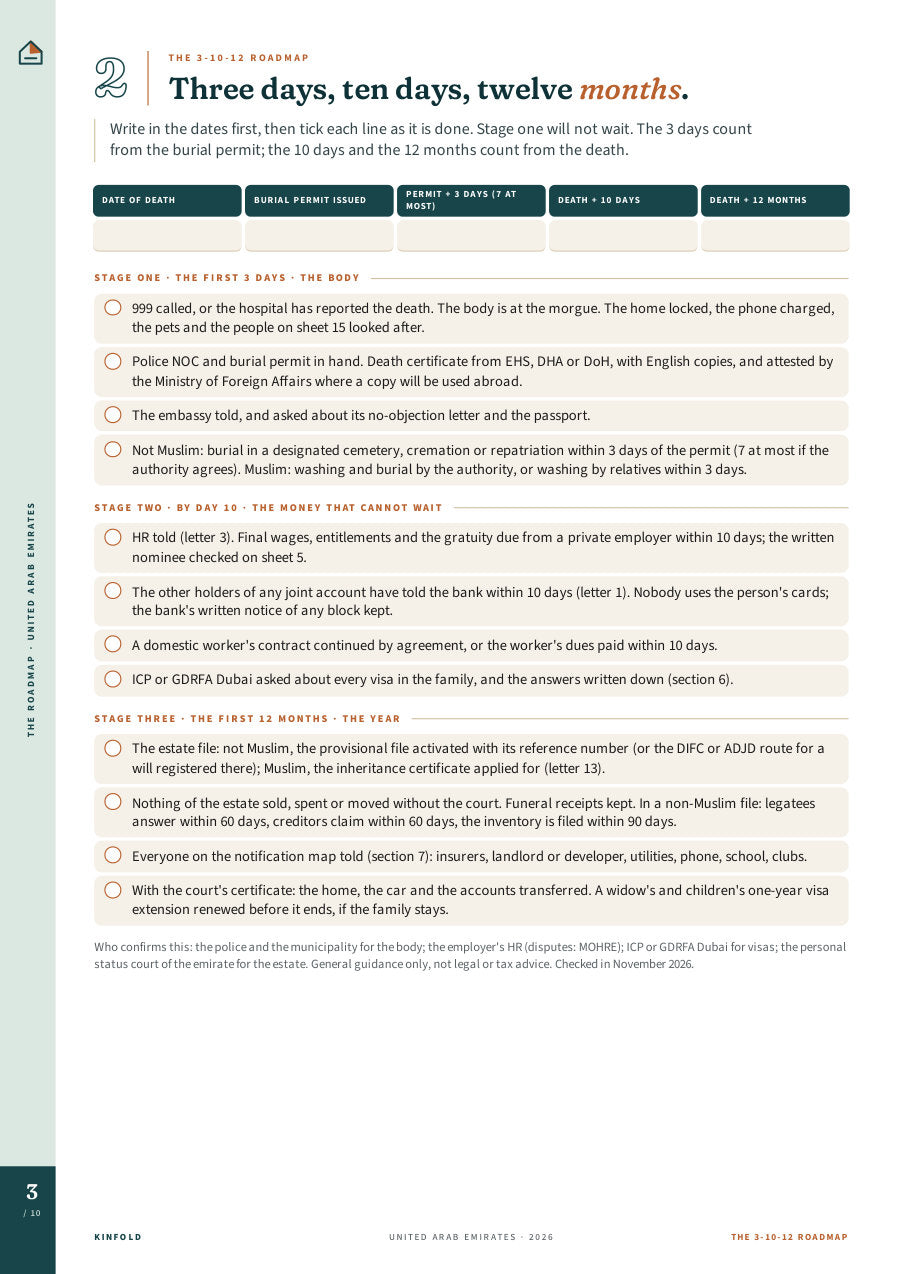
Each number comes from a real UAE rule. 3 days for the body, counted from the burial permit. 10 days for the money that cannot wait, counted from the death. 12 months for the visas and the estate, from the date of death. For every stage the roadmap names the next step, so your family always knows what comes now.
Stage one · The first 3 days · The body
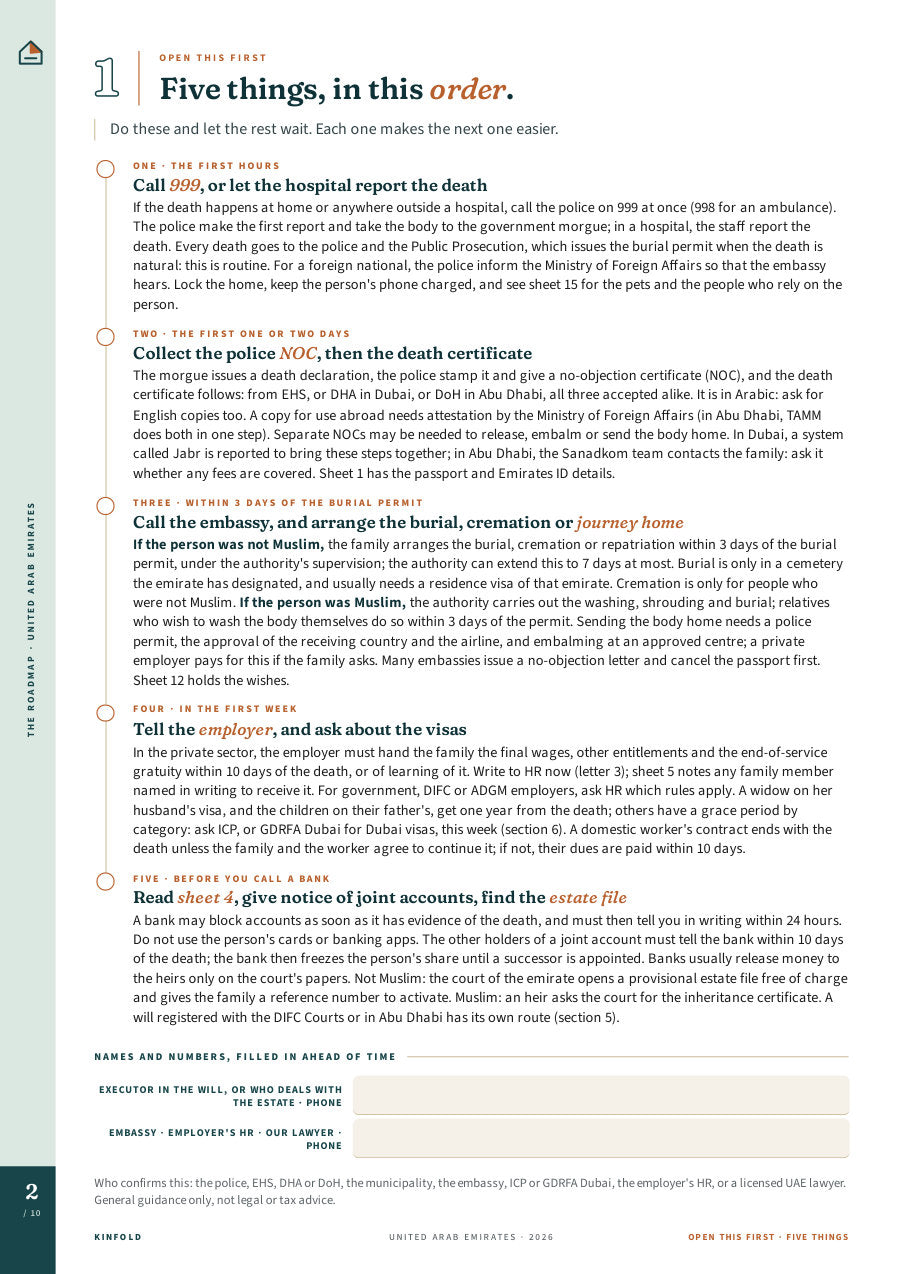
If the death happens at home or anywhere outside a hospital, call the police on 999 (998 for an ambulance); in a hospital, the hospital reports it. The police issue a no-objection certificate (NOC), the Public Prosecution issues the burial permit, and the death certificate comes from EHS, DHA in Dubai or DoH in Abu Dhabi. If the person was not Muslim, the family arranges burial, cremation or repatriation within 3 days of the burial permit, or up to 7 if the authority agrees. If the person was Muslim, the authority carries out the washing and burial; relatives who wish to wash the body themselves do so within those 3 days. Call the embassy or consulate early. In Abu Dhabi, the Sanadkom team contacts the family to help; in Dubai, a system called Jabr is reported to bring the death procedures together.
Days lost chasing the wrong papers, a funeral decided in a rush, and relatives abroad booking flights without knowing what the embassy needs.
Stage two · By day 10 · The money that cannot wait
If the person worked in the private sector, the employer must pay the family the final salary, any entitlements and the end-of-service gratuity within 10 days of the death; if nothing has arrived by then, the letter to HR is ready. If there is a joint account, the other holders must tell the bank within 10 days, and the share of the person who died is frozen from then on. If the person employed a domestic worker, the contract ends with the death unless the family and the worker agree to continue it; if it ends, the worker's dues are paid within 10 days. Then, one by one, with the letters in the folder: the banks, the insurers, the landlord, the school and the utilities.
Nobody follows up on the gratuity, the bank hears about the joint account late, and the nanny or driver is left not knowing what happens next.
Stage three · The first 12 months · The year
A widow who was on her husband's residence visa, and the children on their father's visa, can have their residence extended for one year from the date of death, renewable once, with no new sponsor. Others on the family file have a grace period that depends on their category, up to 6 months, so ask ICP, or GDRFA Dubai for Dubai visas, in the first week. Within the same year come the estate file at the court of the emirate, the inheritance certificate that banks and land departments ask for, the tenancy or the title deed, the car and the schools.
A visa runs out without anyone noticing, something is sold or moved before the court allows it, and the family ends up arguing.
The plan your family follows and the facts only you know, in one folder.
One part is for your family: the roadmap they follow. The other part is for you: the record you fill in so that they can find things. It is written for the whole of the UAE and says clearly where the rules change: for Muslim and non-Muslim estates; between Abu Dhabi, Dubai and Ras Al Khaimah, which run their own courts, and Sharjah, Ajman, Fujairah and Umm Al Quwain, which use the federal courts; and at the DIFC and ADGM, which keep their own will registers.
The Roadmap
It opens with five first steps, then sets out the 3-10-12 roadmap in three stages and month by month, a page on visas (who can stay, and for how long), which offices learn of a death on their own and which do not, and everyone else your family must contact, in order.
The Household Record
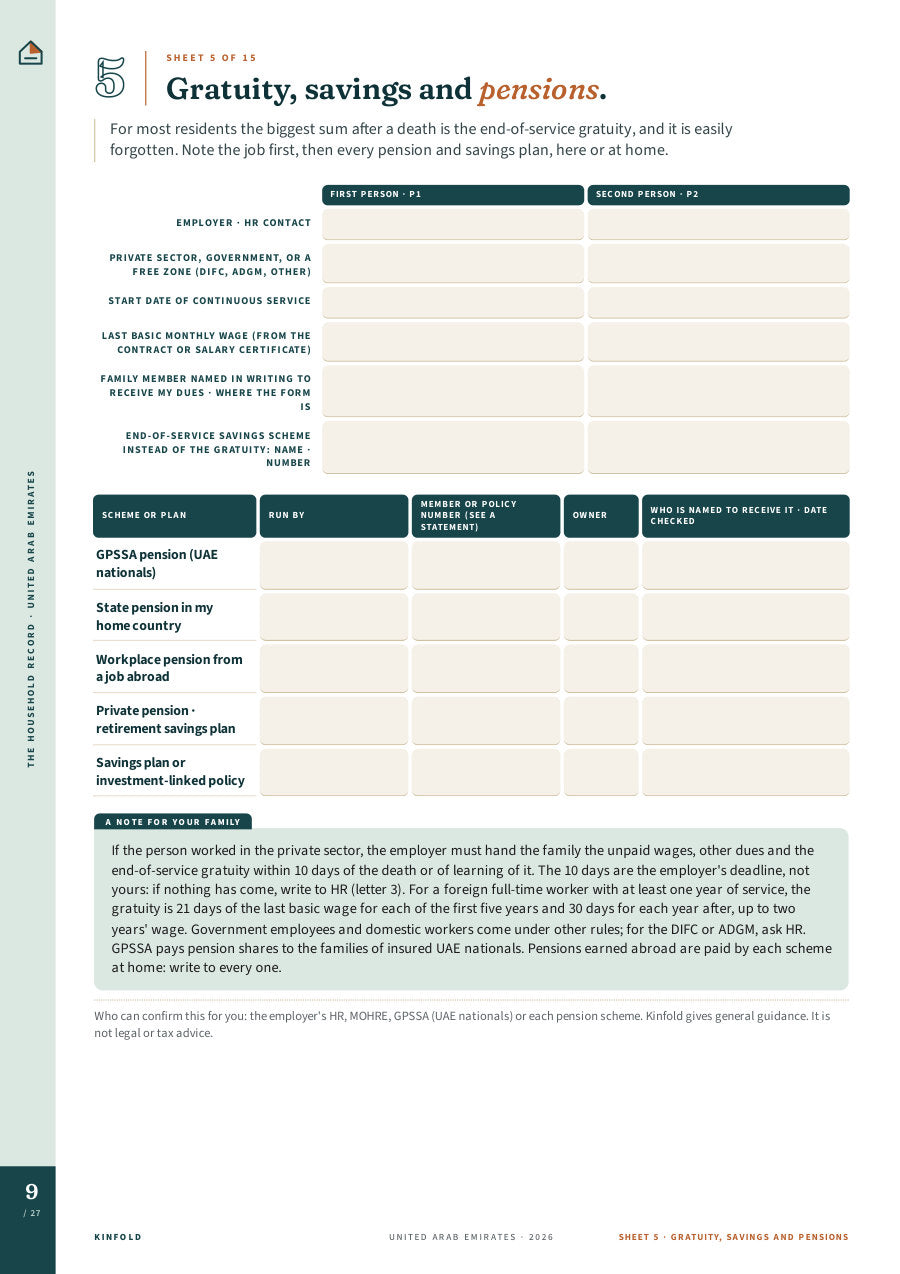
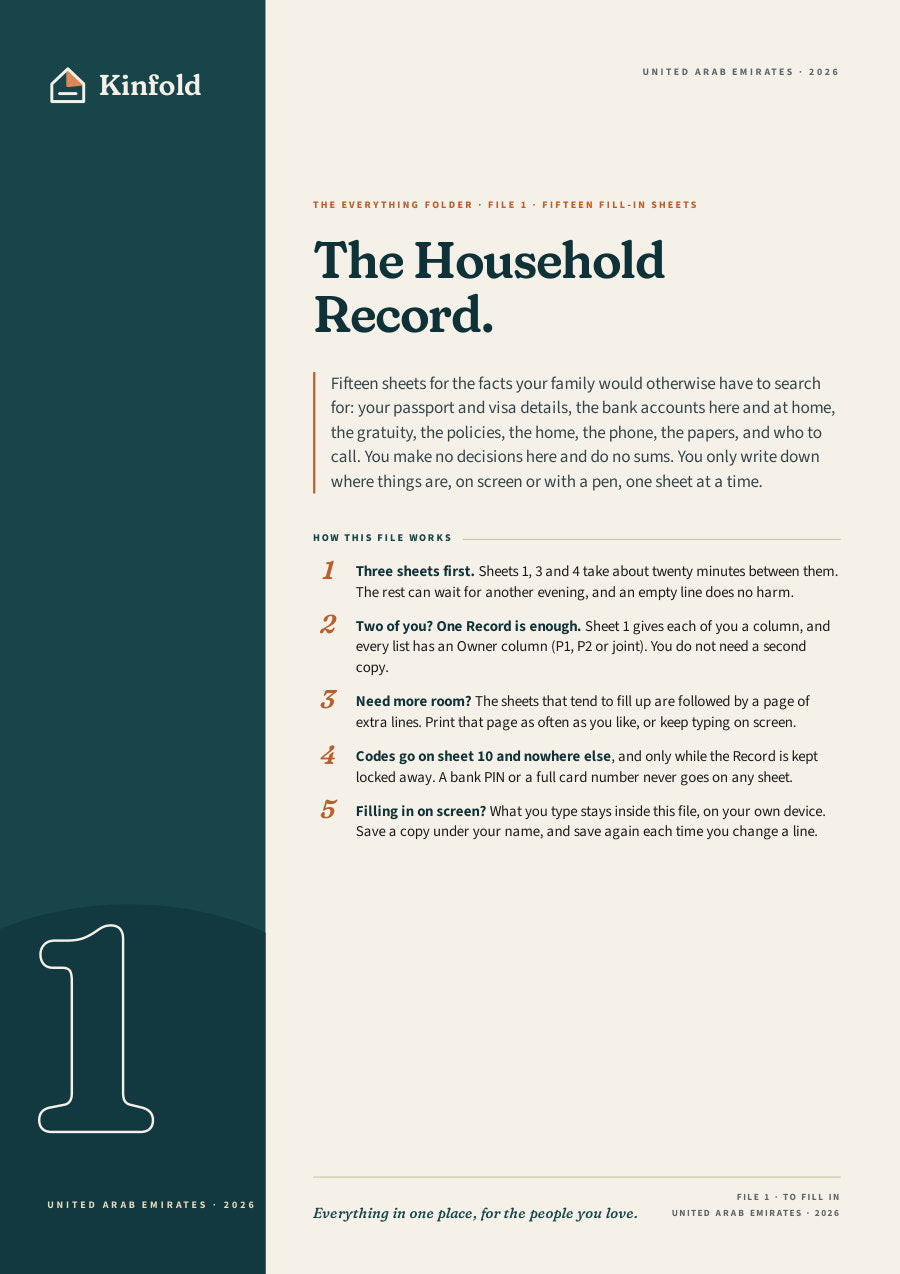
Fifteen sheets with questions to guide you: your passport, Emirates ID and visa details, your accounts here and abroad, your gratuity and the person you named for it, policies and bills, the home and the car, the phone, your registered will and the guardians for your children. Sheet 15, "Pets, plants and people who rely on me", also covers a domestic worker and anyone on your visa.
Letters Ready to Send
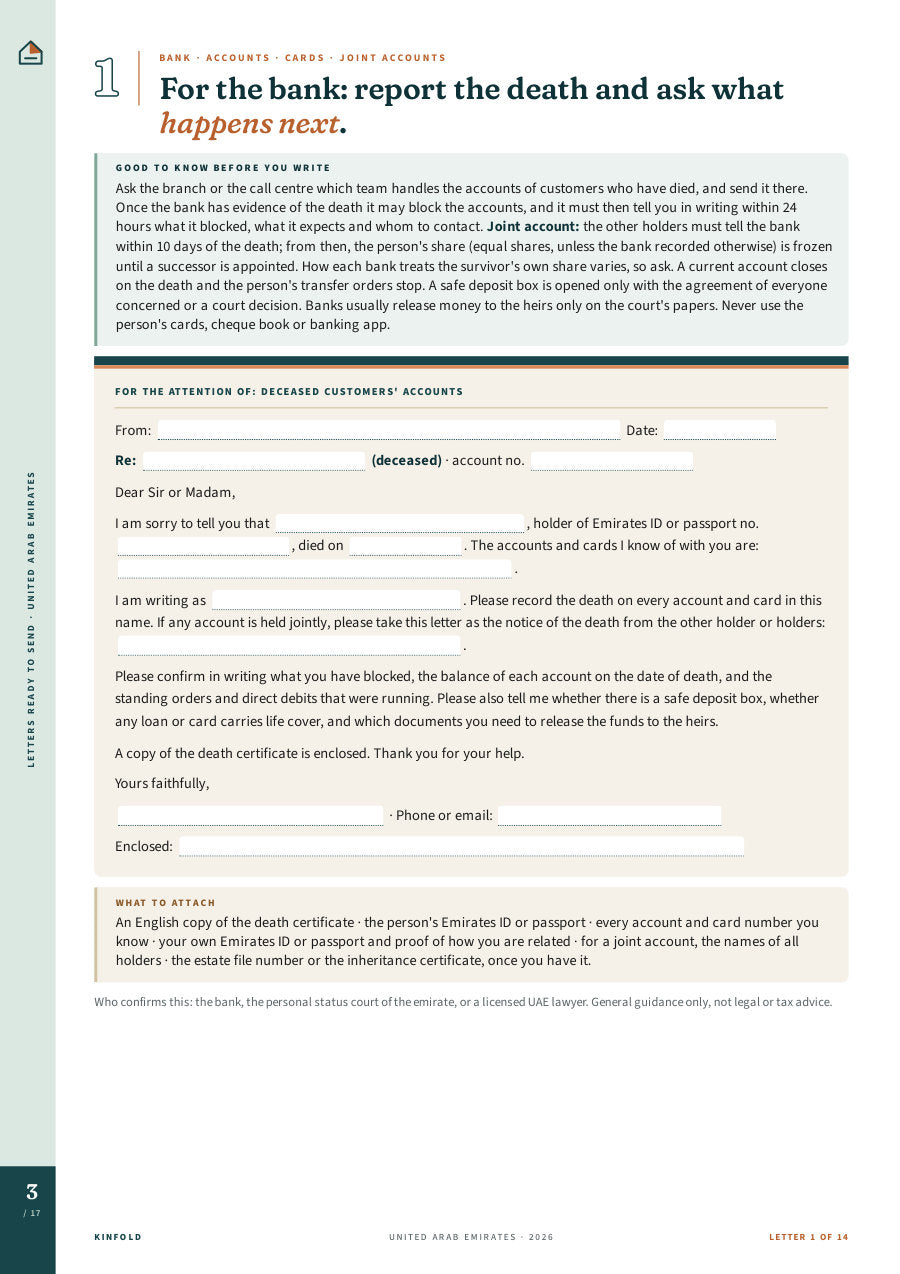
To the bank and the card company, the employer's HR, the life and health insurers, the landlord or developer, the electricity, water and cooling provider, e& or du, the embassy, the broker, the car insurer, the school, the court handling the estate, and last of all the club, gym or subscription to cancel. Fill in the names, sign, and send.
The Executor's Handbook
Written for the executor named in a registered will, the executor or administrator the court appoints, or the heirs themselves. Which rules apply, the estate file and its documents, the inheritance certificate, the inventory within 90 days, notices to creditors, why nothing may be sold or moved before the court allows it, and seven costly mistakes to avoid.
House and Home
For tenants: the lease continues with the heirs, the 30-day notice in Dubai, Ejari or Tawtheeq, the deposit and the post-dated cheques. For owners: registering inherited property with the Dubai Land Department or the land department of your emirate, and the NOCs from the bank or the developer. Plus a short checklist for a home left empty.
The Explainer
The four questions, Muslim and non-Muslim estates, the will registries, the gratuity, the visas, and the fees and home-country taxes that can still apply, all in ordinary words, with the source of each fact named. Then Open This First: three short pages on what each file is for and where to begin.
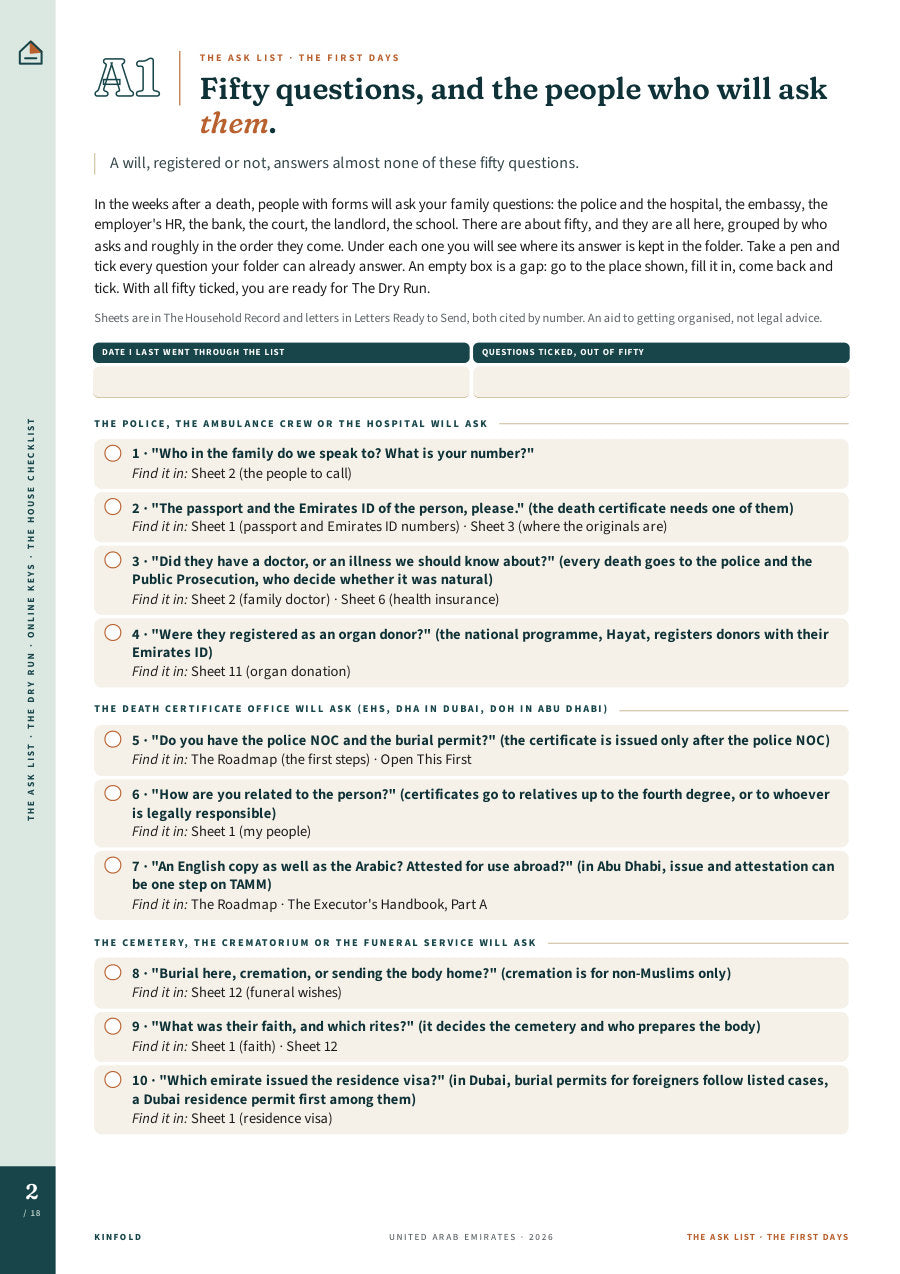
The Ask List. Fifty questions a family meets in the first months, for the hospital, the embassy, the employer, the bank and the court, each pointing to the sheet with the answer.
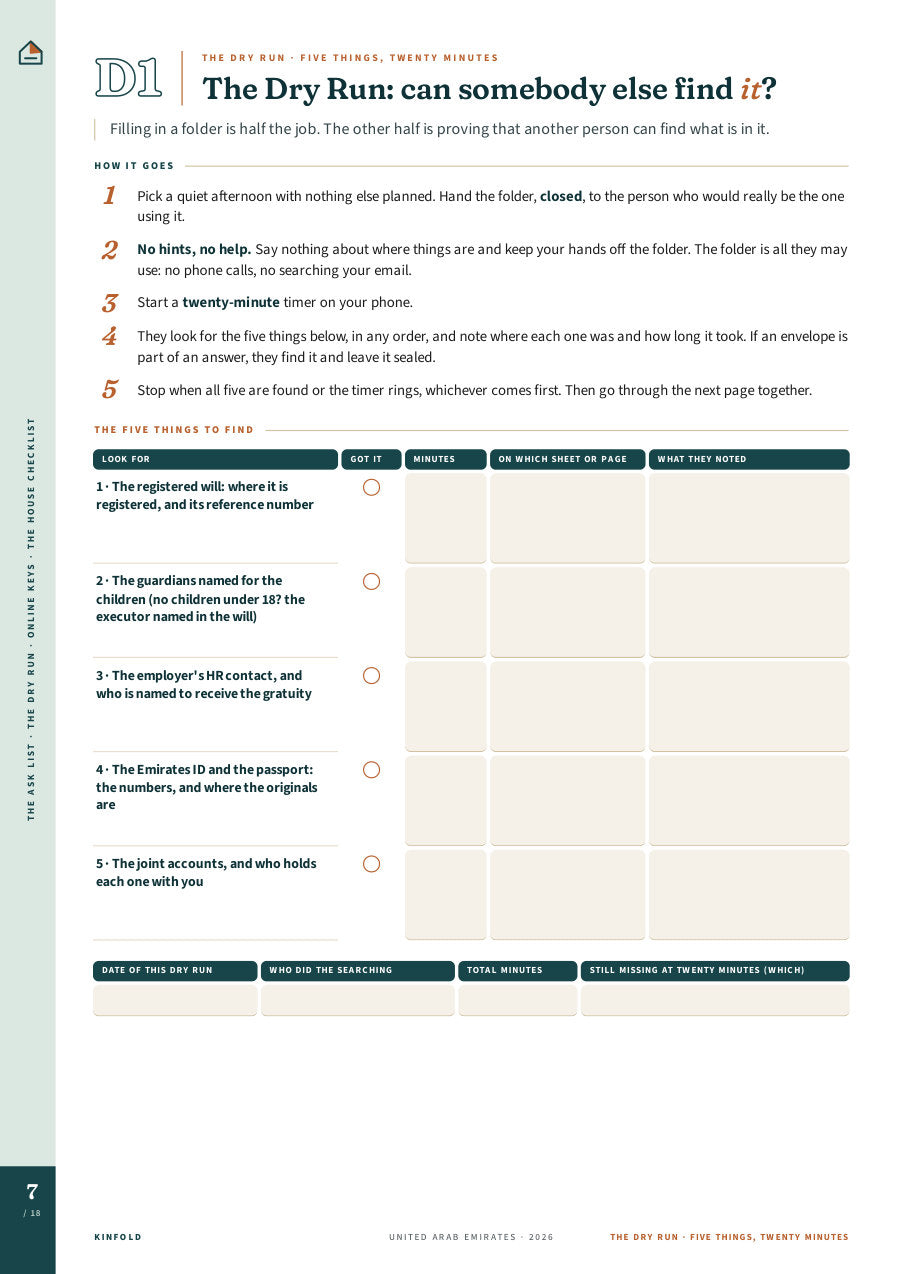
The Dry Run. A timed test: can someone find five key things with the folder in twenty minutes?
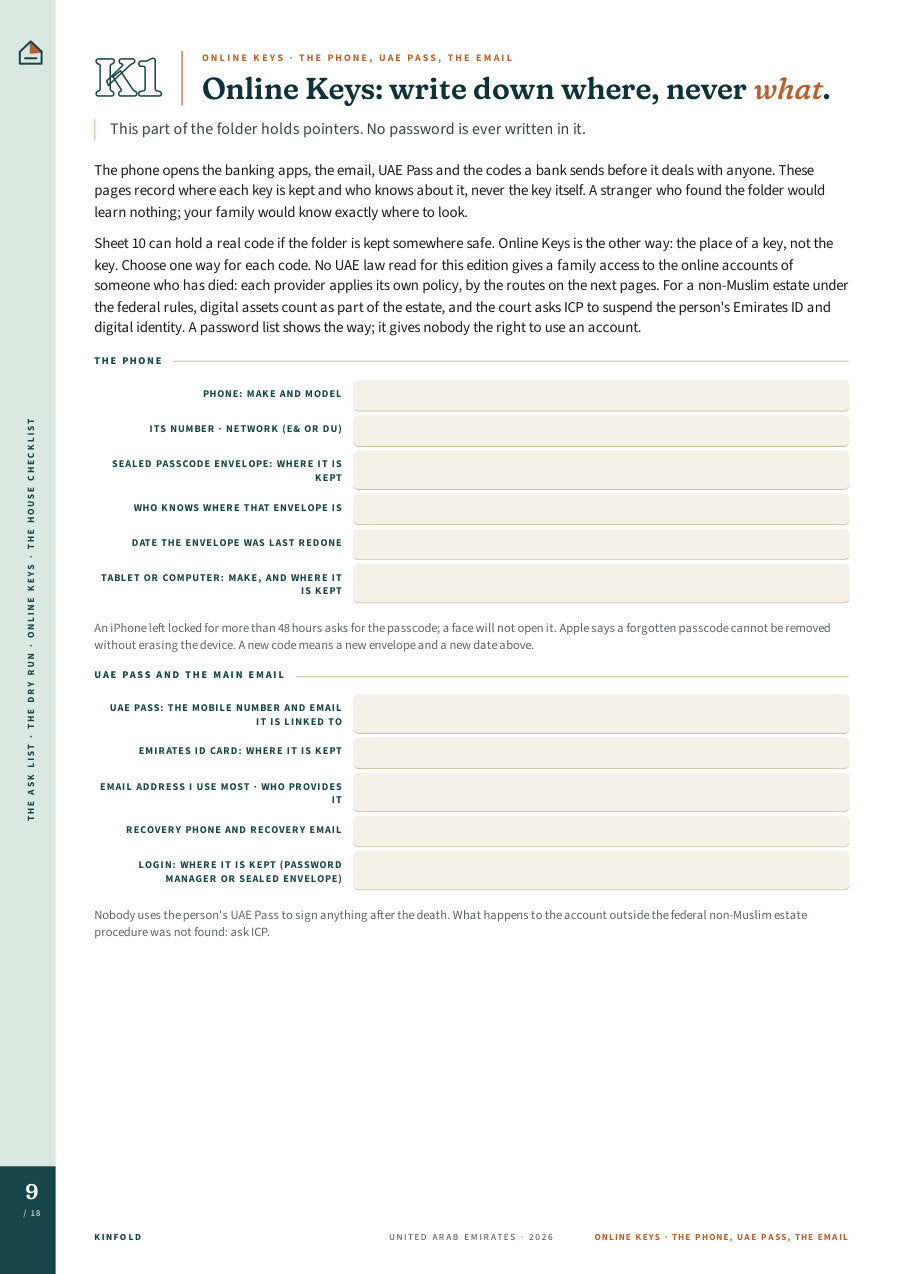
Online Keys. UAE Pass, the banking apps, and the phone number that receives the bank codes.
The House Checklist. Keys, building security, utilities and cooling when nobody is living at home.
Everything is sent by email. Fill in the sheets on screen or print them on A4, then keep the pages in one binder at home.
One calm afternoon at home does most of the work.
Every sheet asks short, simple questions, with a space for each answer. There is no blank page to start from and no law to learn first. Work a little, stop, and come back when it suits you.

Start with three sheets tonight
Who you are (passport, Emirates ID, visa and sponsor), where your papers are kept, and your bank accounts here and abroad. Between them, they cover most questions that come up in the first weeks. Allow about twenty minutes, on screen or with a pen.
Do The Dry Run one weekend
Hand the folder, closed, to the person who would use it, and start a timer. Can they find your registered will and its reference number, the guardians named for your children, the HR contact and your gratuity nominee, your Emirates ID and passport, and your joint accounts? If they can do it within twenty minutes, the folder works. Mark the day you did it on The Dry Run page.
Put it somewhere safe, and tell one person
Keep it with your passports and other important papers, and make sure one person knows the spot. When it is needed, they open The Roadmap and start with the page called "Open this first": five steps, in order. A ten-minute check once a year keeps it up to date: your registered will, the guardians for your children, the beneficiaries on your life cover, and the expiry dates of your Emirates ID and residence visa.
Twelve pages from the UAE edition, open for you to read.
Every page shown here comes from the folder you would receive. Tap a page to see it full size.


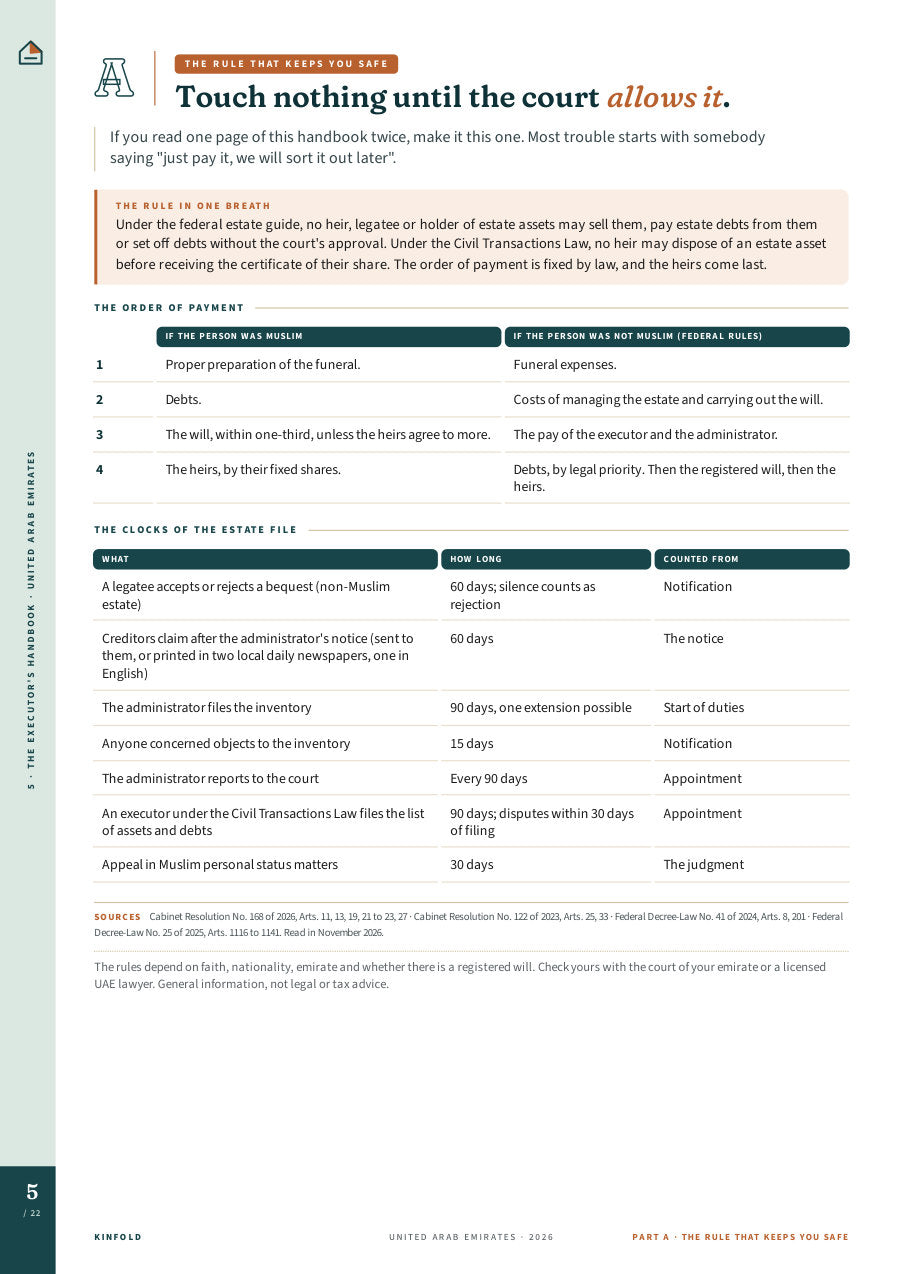
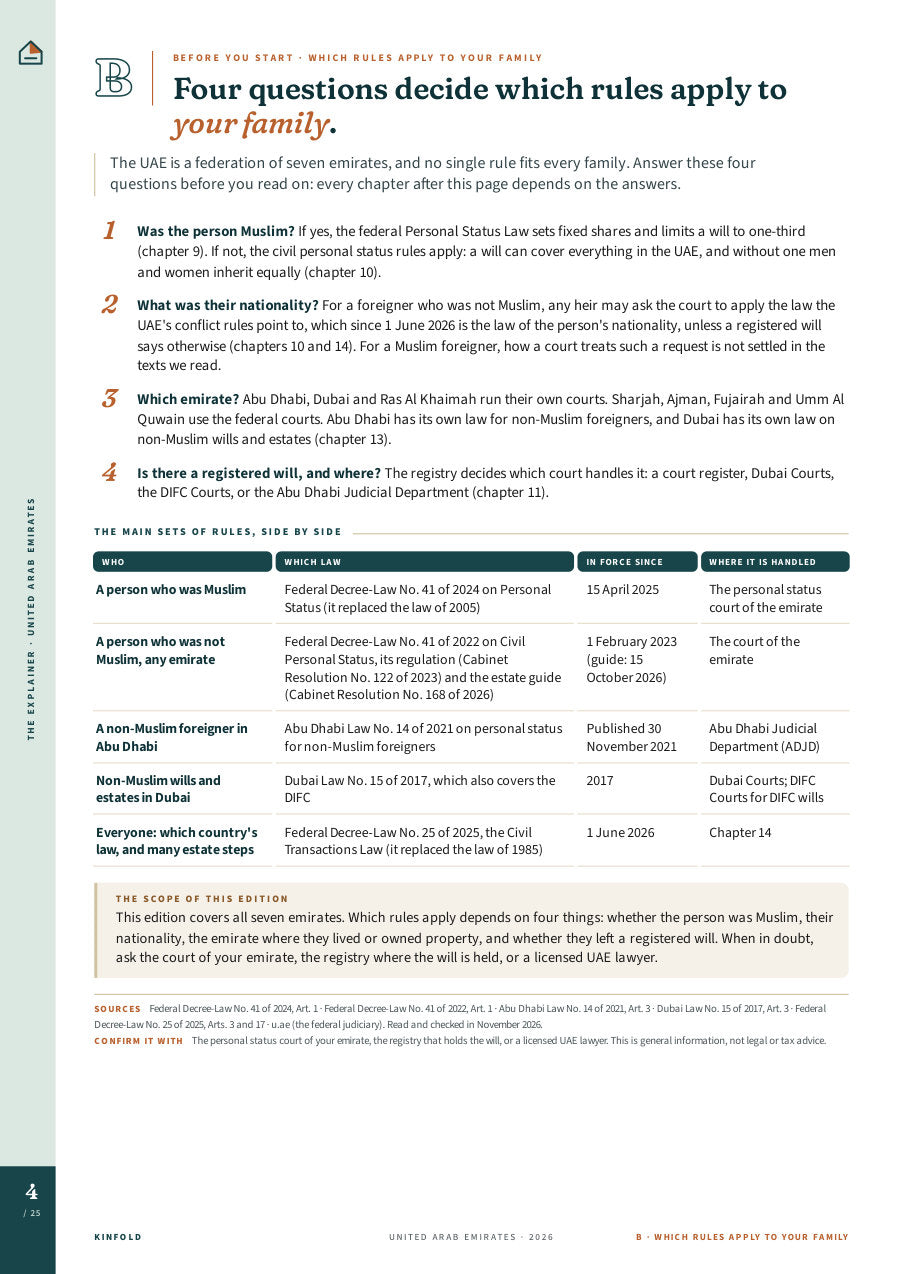
Seven emirates, several sets of rules. We did the reading for you.
Kinfold makes practical paperwork for families. None of us is a lawyer or a tax adviser, and the folder never presents itself as legal advice. Our job is the reading and the organising: we take the rules and turn them into sheets that a family can fill in at home.
For the UAE edition, the rules and deadlines were checked in November 2026, using official sources wherever we could reach them: the federal laws on the UAE Legislation portal, the laws of Dubai and Abu Dhabi, u.ae, the Central Bank Rulebook, the DIFC Courts, the ADGM Courts, the Dubai Land Department and ICP. The sources are listed in The Explainer, so you can check each one.
Where the rules depend on faith, nationality or emirate, the folder says so, and names who confirms: the court of your emirate, the registry that holds the will, or a licensed UAE lawyer.
- Checked in November 2026Laws, rules and deadlines, read at the official source where it could be reached.
- Every source namedThe Explainer lists them, so you can check for yourself.
- All seven emiratesOne edition, with the local differences marked on the page.
One folder, one price, and every part of it included.
You do not have to choose between versions. Everything on this list is in the folder you receive, and every page of it is about the UAE.
Kinfold · The Everything Folder
UAE edition. For anyone who wants to leave their family a plan, with a registered will or without one.
Everything in one place, for the people you love.
- The Roadmap: the five first steps, the 3-10-12 roadmap and everyone to tell, in order
- The Household Record: 15 fill-in sheets with guiding questions
- Letters Ready to Send: 14 letters with the wording done
- The Executor's Handbook: the estate file step by step, with a calendar from the first day to the end of the year
- House and Home, whether you rent or own
- Four extra tools: The Ask List, The Dry Run, Online Keys, The House Checklist
- Open This First, and The Explainer in everyday words
- UAE rules throughout: Muslim and non-Muslim estates, all seven emirates, the DIFC and ADGM
- A single folder covers a couple
- Delivered by email, with Word versions of files 1 to 5
One payment. No subscription.
60-day money-back guarantee
To put it in context: notarising a will through the ADGM Courts, applying for a grant of probate at the DIFC Courts and registering inherited property at the Dubai Land Department all carry official fees, and a licensed UAE lawyer charges for the work on top. Kinfold does not replace a lawyer. It means your family, and anyone helping them, start with every detail the first calls will ask for.
60 days to decide. If it is not right for your family, you get a full refund.
Go through it properly: read The Explainer, complete a few sheets and try The Dry Run with your family. If you decide it would not make things easier for them, send us a message through the contact page within 60 days and you get the full amount back. A short note is all it takes, and you do not have to give a reason.
Clear answers before you buy.
Is it just a set of blank forms?
No. The core of it is a roadmap that sets out what needs doing, who needs to hear, and in what order, in three stages: the first 3 days, by day 10, and the first 12 months. Your answers on the sheets connect to it, so your family simply follows the steps.
I already have a will. Is this still useful?
Yes. They do separate jobs. A will deals with who inherits, within the limits of the law that applies to you. It does not show your family where anything is, who to call in HR, which contracts to cancel or when each visa runs out. The folder covers that practical side and sits next to the will. It also records where your will is registered and its reference number, because a will nobody can find, or one made abroad and never registered here, can mean extra court steps in the UAE.
Does it matter whether we are Muslim?
Yes, and the folder says so plainly and with respect. If the person who died was Muslim, the federal Personal Status Law sets the shares of the heirs, and a will can cover at most one-third of the estate and cannot favour an heir unless the other heirs agree. Under that law a husband or wife of another faith does not inherit, although a will can still leave them something within the one-third. If the person who died was not Muslim, the civil law lets them leave all their UAE assets by will, and with no will a husband or wife takes half and the children share the rest equally. Some cases are not settled, for example a Muslim expatriate who wants the law of the home country applied: there the folder sends you to a licensed UAE lawyer.
Is it the same in every emirate?
Mostly, but not completely, and the folder marks the differences. Abu Dhabi, Dubai and Ras Al Khaimah run their own courts; Sharjah, Ajman, Fujairah and Umm Al Quwain use the federal courts. Abu Dhabi has its own law for non-Muslim foreigners, Dubai has its own law on non-Muslim wills, and the DIFC and ADGM keep their own will registers. Burial rules, tenancy rules and the utility company also change from one emirate to another. This edition covers all seven emirates. It is general information, not legal advice, so confirm the details with the court of your emirate or a licensed UAE lawyer.
I have accounts and property back home. Does the folder cover them?
It records them, so your family knows they exist and who to contact. It also explains the key point: assets in another country follow the rules of that country, and a UAE will may not be enforced there, so for those assets your family will need advice in that country. And documents that come from abroad, such as a marriage certificate or a foreign court decision, need attestation and a legal translation into Arabic before UAE offices accept them.
How will I receive it?
By email. After payment, an email arrives with a link to your files. Keep them on your computer and fill them in there, or print them on A4 and put them in a binder.
What if I do not have a printer?
That is fine. Every sheet can be filled in and saved on screen, and files 1 to 5 also come as Word documents. If your family would rather have paper, print The Roadmap first, starting with the five first steps and the 3-10-12 roadmap. A home printer works, and so does a typing centre or print shop.
Who can see what I type?
Only you, and anyone you choose to show it to. It stays on your own computer: we never receive what you type, and you do not need an account, an app or any cloud storage. Do not write bank PINs or full card numbers in it, because nobody handling an estate needs them. Passwords go on a single sheet, either the passwords themselves or a note saying where each one is stored. Store the folder safely: in a home safe, a drawer that locks, or with your lawyer.
Once the death is reported, does everyone find out?
Only some offices. The hospital tells the police and the health authority, and the police tell the Public Prosecution and, for a foreign national, the Ministry of Foreign Affairs, so that the embassy is informed. In most non-Muslim estates, the court opens an estate file and writes to the Central Bank, ICP and the land and vehicle departments. In Dubai, a system called Jabr is reported to send the death certificate on to the relevant bodies. As far as we know, there is no single service that tells everyone else: the employer, the landlord, the school, the insurers, the utilities, e& or du and the clubs usually hear it from the family, one by one. The fourteen letters are written for exactly that.
Can I buy it for my parents or a friend?
Yes, if they live in the UAE. Buy it, pass the files on, and fill in the first sheet together. An easy way to raise it: "I am doing mine. Shall we do yours at the same time?" If they live in another country, this edition is not the right one for them, because the rules there are different.
What if I buy it and never fill it in?
Begin with just three sheets, which take about twenty minutes. Try The Dry Run on a weekend after that. And if you decide it is not for you, the 60-day guarantee gives you your money back.
Is this legal advice?
No. Kinfold does not replace a will, and it gives no legal, tax or financial advice. It is general information and a practical plan for everything a will leaves out, and it tells your family which office to go to: the court of your emirate, the registry that holds the will, the police and the health authority, ICP or GDRFA Dubai, the employer's HR or MOHRE, the embassy, or a licensed UAE lawyer. It is also the reason the folder contains no will template: which will is valid, and where it should be registered, depends on your faith, your nationality and your emirate.
You built a life here for them. Make the hardest weeks easier to get through.
One afternoon now saves them months of searching later. Three sheets tonight, The Dry Run on a weekend, and a safe spot for the folder that one person knows.
One payment. No subscription.
Kinfold is not a will. It is general information, not legal, tax or financial advice: an organiser and a practical plan that helps your family find things and know where to begin. This edition covers all seven emirates. Which rules apply depends on four things: whether the person was Muslim, their nationality, the emirate where they lived or owned property, and whether they left a registered will. Rules, fees and deadlines change, so confirm locally before acting: ask the court of your emirate, the registry where the will is held, or a licensed UAE lawyer.
Everything in one place, for the people you love.
© 2026 Kinfold · The Everything Folder · UAE edition